
A downspout can be doing its job at the roof and still leave you with a wet patch beside the house. The missing question is what happens after the water reaches the bottom. Does it keep traveling away, turn back toward the wall, or collect somewhere that never seems to dry?
For a new Northern Alabama homeowner, that is a useful detail to learn before buying a longer pipe or digging a garden. Start with the visible route from roof to yard. You are not trying to diagnose a foundation from the lawn; you are separating a maintenance task from a drainage-design question so you can make the right next call.
Follow the whole route, not just the downspout
Gutters collect runoff along the roof edge; downspouts carry that collected water to ground level. The Building America guide to gutters and downspouts treats them as part of a larger water-management system. A clean gutter is only the first part of the route.
From a safe ground-level position, look for four things: where roof water is collected, where it comes down, where the outlet ends and which way the surrounding surface falls. Do this in ordinary safe conditions—not during lightning, flooding or a storm that makes it unsafe to be outside. Photographs taken afterward can help you explain a recurring wet area without climbing a ladder or entering a crawl space.
A practical observation is specific: “Water spills over this corner,” “This joint is disconnected,” or “The outlet is clear, but water returns toward this wall.” Those descriptions point to different work. A note that the yard is simply “wet” does not tell a gutter contractor or drainage professional nearly as much.
The outlet needs an away-going path
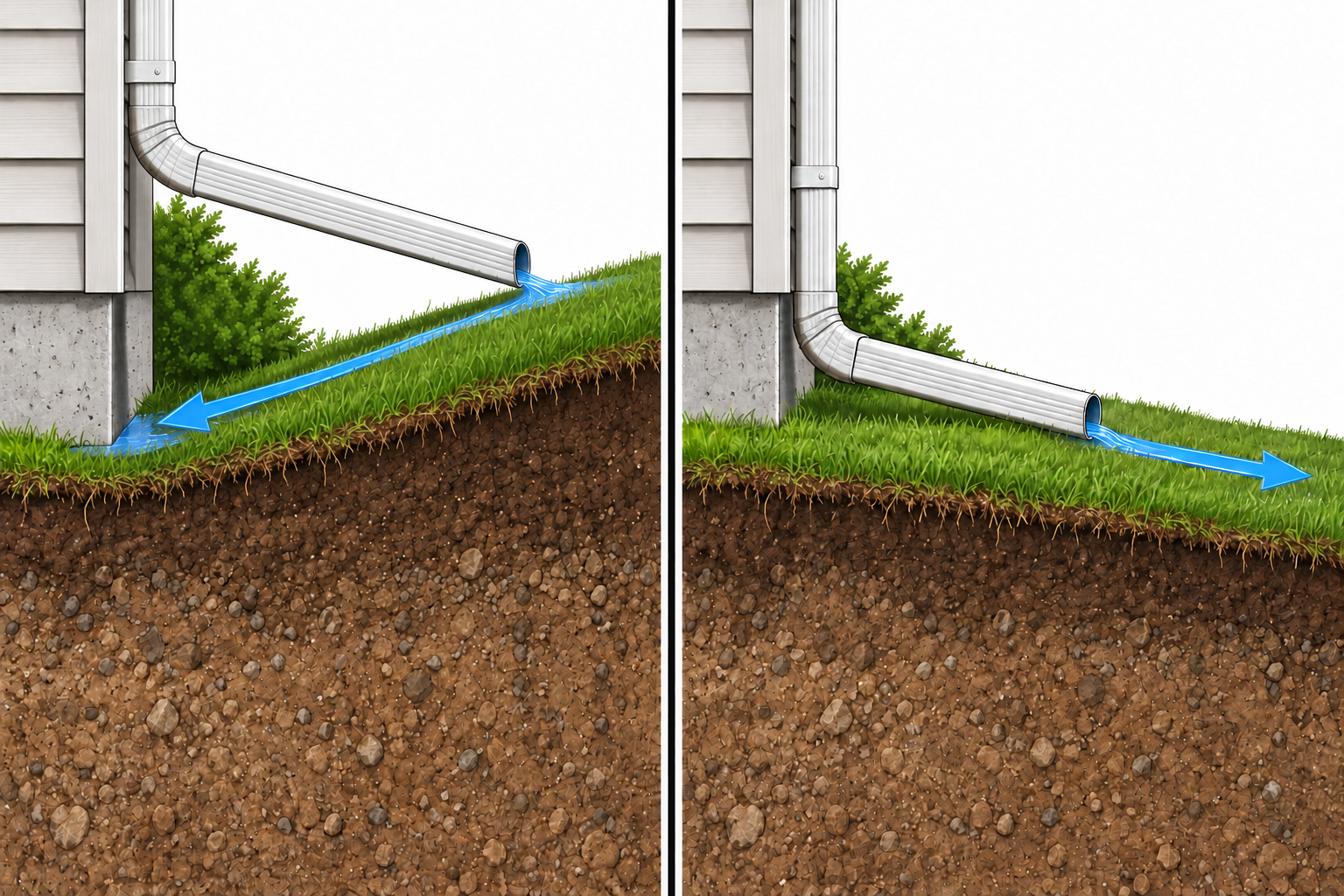
The Building America guide describes daylight discharge at least five feet from the foundation onto ground that slopes away, rather than allowing water to return toward the building. That is a useful published design reference, not a universal prescription for every lot or a statement of your local code. The available space, surface levels and permitted destination still matter.
Think of the extension as a delivery route, not a disposal system. If its outlet ends in a depression next to the home, length alone has not solved the problem. If the next section of ground rises away from the house, water can come back toward the low point at the wall. The paired illustration makes that relationship easier to see; its slopes and clearances are deliberately exaggerated, not construction dimensions.
When a downspout disappears into an underground pipe, the next useful fact is where that pipe goes. Ask for an existing drainage plan or service record and have a qualified professional identify an unknown or blocked outlet. Do not assume that a buried connection means the water has reached a suitable destination, and do not connect new roof runoff to an unidentified drain.
Use the symptom to choose the next step
| What you can observe | What it helps you decide |
|---|---|
| Water spills over the gutter or a joint leaks. | Arrange gutter/downspout inspection and maintenance; the outlet route still needs review afterward. |
| The outlet flows, but water runs back toward the wall. | Ask for a site-drainage assessment, not just another length of extension. |
| A low spot remains wet well after surrounding ground dries. | Investigate soil, groundwater and drainage conditions before choosing a rain garden. |
| Indoor dampness persists without a clear roof-water connection. | Have the moisture source assessed rather than assuming a gutter fix will address it. |
These are sorting questions, not diagnoses. Take dated photos from the same safe viewpoint and record roughly when rain ended and when the area dried. Include recent changes—a new patio, moved extension or landscape work—when you describe the problem. You do not need to decide what caused it before asking for help.
University of Minnesota Extension distinguishes rain or groundwater, indoor moisture sources and humid outdoor air that condenses on cooler surfaces as different sources of basement moisture. Its explanation of moisture sources is useful for that distinction; it is not evidence that a North Alabama home has the same conditions as a Minnesota basement. Persistent water entry, deterioration or an unclear source deserves a qualified assessment. Do not enter standing water or confined spaces to investigate.
A rain garden is not a name for the wettest spot
Alabama Extension advises against putting a rain garden in a site that stays wet through the rainy season. A planted depression needs suitable soil and a planned route for water. Simply planting the area where water already stands may leave the underlying problem unchanged.
For captured roof runoff, Alabama Extension calls for a rain garden at least ten feet downslope of the downspout and warns against placing it uphill of a house or over a septic drainfield. Read its site-selection guidance as a whole: the location must also account for nearby structures, slopes and where overflow can safely go. The five-foot outlet reference and ten-foot rain-garden reference answer different design questions; they are not interchangeable measurements.
Alabama Extension recommends an infiltration test at the proposed rain-garden location, repeating the filling and drainage measurements to assess saturated soil behavior. Its soil-assessment instructions explain why a quick look at the lawn is not enough. Before any digging, arrange the required utility locating and any site approvals; ask a landscape professional to evaluate unsuitable or uncertain conditions rather than experimenting beside the foundation.
A septic property adds another layer to the site plan. The drainfield needs protected space, not extra runoff directed into it. If you are comparing rural properties, the related guide to fitting a home and septic system onto a Lawrence County site explains why the tank is only one part of the wastewater layout. Its local permitting details apply to Lawrence County; the physical distinction helps explain why an apparently empty part of a yard may already have an important job.
Plan the overflow before the planting
Alabama Extension says rain gardens normally overflow during large storms and directs that overflow away from structures, steep slopes and neighboring properties. This is the question to settle before picking plants: when the intended area cannot take more water, what happens next?
Ask a proposed drainage contractor or landscape designer to show the full route on a simple site sketch: source, conveyance, outlet, receiving area and overflow. Include the actual house, paved areas, property boundaries and known utilities or septic components. A proposal should explain how the work affects those features, not merely name a product. Where discharge involves a public drainage system, an easement or neighboring land, get the relevant permissions and professional guidance before changing the route.
For an existing home, keep that explanation with the maintenance records. For a purchase, use the inspection period to understand visible concerns and obtain the appropriate assessment; a dry-day showing cannot establish how a yard behaves in rain. Sellers can provide known plans, receipts and repair history without turning those records into a promise that the property will never have water problems.
Conclusion: know the destination before choosing the fix
The useful homeowner habit is to follow water beyond the downspout. Roof collection, the extension, ground slope, soil and overflow all contribute to what happens next. A disconnected piece may be a maintenance task; reverse grade or a permanently wet receiving area calls for a broader look.
Once you know the route, you can explain the problem more clearly and compare proposed work on something better than pipe length alone. Keep this drainage review alongside routine seasonal care; the North Alabama pre-freeze checklist covers separate cold-weather tasks for outdoor water connections, heating and the home’s absence plan.
Want Personalized Real Estate Help?
Buying, selling or getting settled in Northern Alabama? I can help you organize property questions and connect the home search or sale with the right inspections and records. Contact me to talk about your plans. A drainage professional can assess the site while we keep the property decision grounded in clear information.
Sharing is Caring:
Author