
Your first fall in a tree-filled North Alabama yard can leave you with two seemingly opposite instructions: clear the leaves, and leave the leaves. Both can make sense. The useful question is where those leaves have landed—and what you need that part of the yard to do.
A wooded border, a small lawn, a planted bed and the curb are different places, even on the same property. Before buying bags or scheduling a whole-yard cleanup, separate the leaves you can keep from the ones that need moving. That gives you a more manageable job and a clearer picture of the outdoor upkeep that comes with your home.
Featured image: an AI-generated illustration of a fictional home landscape, not a property listing.
Start with the destination, not the rake
Use this as a sorting plan, then read the details below. It is a practical synthesis of Alabama Extension guidance and the city collection example—not a prescription to spread the same depth of leaves everywhere.
| Where they are | A useful choice | What changes the decision |
|---|---|---|
| Wooded or deliberately natural border | Leave suitable existing litter in place. | Choose a quiet area where it will not wash into a drain. |
| Lawn you want to retain | Chop a manageable amount; move excess elsewhere. | A continuous blanket is different from small dispersed fragments. |
| Managed shrub or landscape bed | Use shredded leaves as mulch where appropriate. | Account for mulch already present; do not pile against trunks. |
| Compost area | Reserve leaves as a carbon-rich ingredient. | Provide air and suitable moisture; a sealed wet heap is not the goal. |
| Walkway, curb or drainage opening | Move leaves to a suitable on-site use or approved collection. | Keep the walking route and water path clear; never use the street as storage. |
Keep a quiet leaf area where it belongs
Alabama Extension’s September 2025 “Leave the Leaves” guidance explains why leaf litter matters: it provides overwintering shelter for insects and foraging habitat for wildlife. A tidy entrance does not require stripping every sheltered corner of the property bare.
Consider a defined wooded edge or natural area away from your walking route. The distinction is intentional use: you are keeping a habitat area, not abandoning a pile across the lawn. If you hire help, point out that boundary before work starts. “Clear this path, keep that wooded strip” is much more useful than “clean up everything.”
Alabama Extension’s leaf-recycling guide specifically recommends leaving fallen leaves in heavily wooded areas. In a maintained landscape, it also identifies leaf mulch and compost as ways to use the material on site. You do not have to choose one method for the entire yard.
What chopped leaves look like on a lawn
For turf you intend to keep, the difference is between dispersed pieces and a covering layer. University of Illinois Extension describes mowing leaves into small pieces as one option for keeping their organic material on the lawn. That is a physical technique, not a reason to adopt an Illinois fertilizer schedule or assume every North Alabama grass needs the same mowing height.
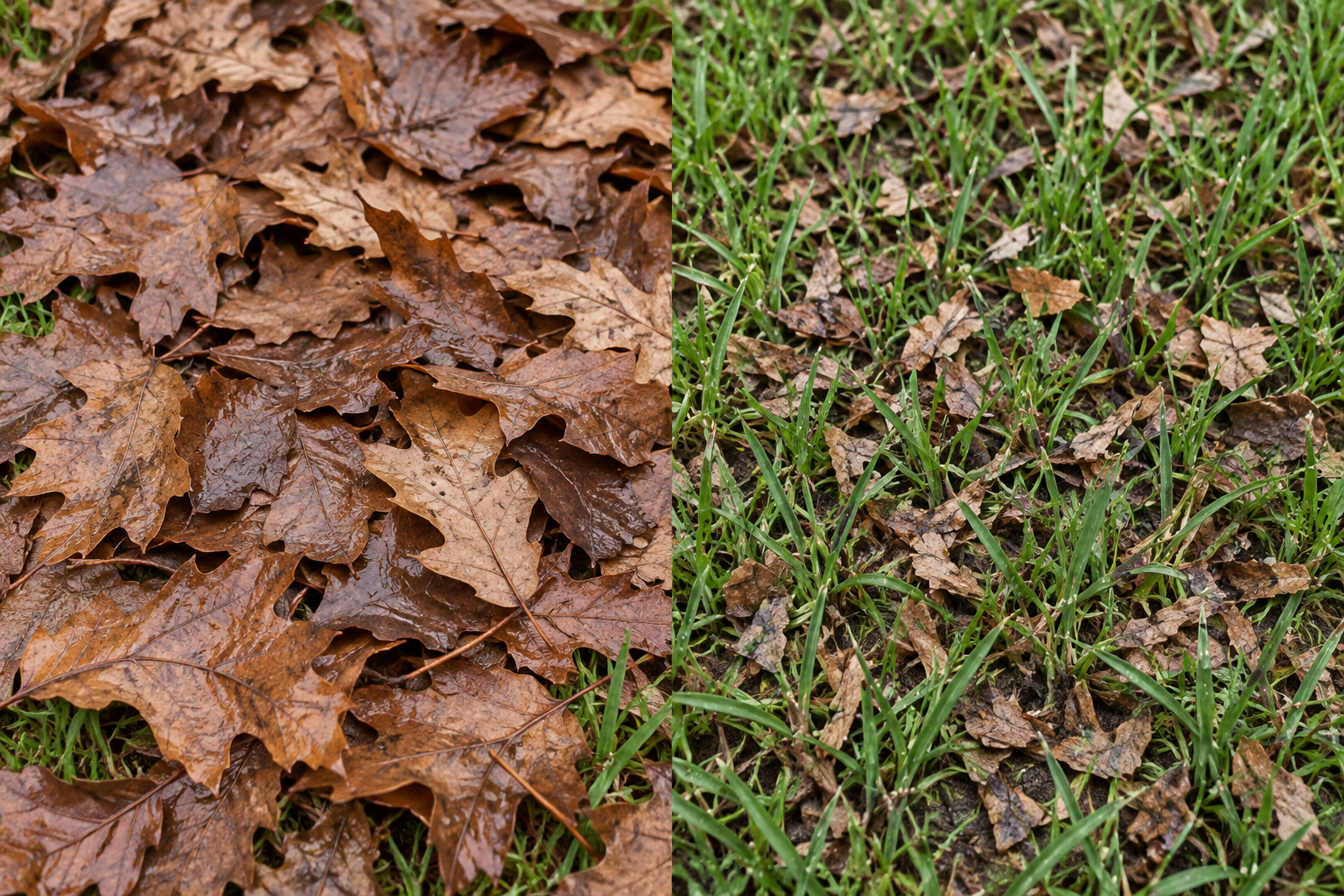
Look at the result, not just whether you made a pass over the yard. Small pieces among visible blades are easier to distinguish in the illustration than in the phrase “mulch the leaves.” If you still have a blanket, move some of that material to an appropriate bed, compost area or collection bag rather than repeatedly trying to force all of it into the lawn.
Keep equipment use within its instructions and your ability; this is not a recommendation to mow wet ground or lower the deck to grind a pile. A rake is a perfectly reasonable way to separate excess material. The goal is a usable lawn plus a sensible destination for what it cannot accommodate.
In beds, count the mulch you already have
Alabama Extension’s landscape-mulch guide recommends a 2–3-inch layer for shredded tree leaves and notes that they mat less readily than whole leaves. It also warns that repeated heavy mulching can cover plant crowns and that mulch piled against a tree trunk can hold damaging moisture.
That measurement is a layer to assess, not an automatic annual top-up. Part the old material first. A bed that already has a substantial layer does not need another full layer simply because the trees supplied it. Keep the trunk visible rather than building a mound around it. Whole leaves are not interchangeable with shredded mulch: the same guide does not recommend whole tree leaves for herbaceous perennials.
For a newcomer, this is a useful distinction to make with a landscape service: which beds need material, which need thinning, and which wooded areas should be left alone? A yard-wide instruction can erase those differences.
Save some for compost without creating a soggy heap
Leaves can be the stored “brown” material you combine with suitable fresh ingredients over time. Alabama Extension’s composting guide explains that decomposition depends on air, moisture, carbon and nitrogen. Material should be moist rather than dripping; too little oxygen can produce unpleasant odors.
You do not need to turn that into a chemistry project to make a useful first decision. Choose whether you have a place you can actually maintain, access and turn. If the answer is no, a collection option may be more realistic than starting a pile you cannot manage. If the answer is yes, keep spare leaves available instead of mixing every bag into one wet mass at once.
The leaf-recycling guide also advises choosing a well-drained compost location with water available and avoiding placement against wooden buildings or trees. Do not promise yourself finished compost by a particular holiday: the starting materials and how you manage them affect the result.
Collection rules follow your service address
Here is a concrete local example. In its October 2, 2025 fall-cleanup notice, Huntsville tells residents to use paper or biodegradable leaf bags of no more than 32 gallons and 50 pounds, with bags curbside by 7 a.m. on collection day. The notice also says not to blow leaves into the street. Those are Huntsville instructions, not a rule for all 13 counties.
Before buying a stack of bags elsewhere, identify who actually collects yard waste at your address and ask about accepted containers, weight limits, placement and the next collection. A postal city name is not a reliable substitute for knowing your service provider. Save the provider’s specific instructions with your household information so a helper does not have to guess.
Keep leaves out of drainage openings rather than sweeping them out of sight. The same Huntsville notice explains that blocked curbs and drains can back water up and that wet leaf accumulations can be slick. Work only where you can do so safely; do not enter traffic, lift a public grate or step into floodwater to remove debris. Report a blockage that you cannot safely reach.
If the leaves are gone but water still collects where it should not, that is a different question. My roof-runoff and downspout drainage walkthrough helps you follow the water beyond the gutter instead of assuming another cleanup will solve the whole problem.
Sources checked October 26, 2026. Huntsville collection details above come from its dated October 2025 notice; check your actual provider’s current instructions before setting material out.
One yard can use several approaches
Imagine a home with a small front lawn, established shrub beds and a wooded back boundary. On your first pass, clear the entrance and collect material from the curb-side area. Leave the suitable woodland litter undisturbed. Assess the lawn separately, moving excess leaves before deciding whether the remaining amount can be chopped and dispersed.
Next, part the existing mulch in the beds. Only the beds that need it receive appropriate shredded material. Reserve a manageable amount for compost if you have a suitable place; send the remainder through the actual collection service. This is a hypothetical workflow, not a claim about every Northern Alabama property. Its advantage is that you decide the destination before handling the same pile several times.
For buyers comparing homes, that same walk tells you more than “the lot has mature trees.” Where will leaves collect? Which areas do you want maintained as lawn? Is there a practical place for compost, and who provides collection? These are everyday ownership questions you can consider alongside the porch, kitchen and floor plan.
Conclusion: Give the leaves a job—or a proper exit
You can enjoy a leafy yard without treating every fallen leaf as trash or every pile as habitat. Keep suitable natural areas, use manageable material where it helps, and clear the places people and water need to pass. The most useful fall plan is specific to the yard in front of you—and realistic about the time you want to spend maintaining it.
Want Personalized Real Estate Help?
If you are buying, selling or relocating in Northern Alabama, I can help you think through how a home’s outdoor space fits your everyday routine—not just how it looks in a listing. Contact me to talk about the home and lifestyle you are looking for.
Sharing is Caring:
Author