
You have unpacked the kitchen, flattened a few moving boxes and found a half-used can of paint in the garage. It is tempting to make one cleanup pile. In the Huntsville area, those items need different plans—and the recycling habits you brought from another city may not fit the local cart.
The useful distinction is between ordinary curbside recyclables, household hazardous-waste drop-off and materials accepted by neither of those routes. Start with the service at your actual home, then sort the objects. That makes the first month easier without turning every empty container into a research project.
First, establish which service reaches your home
RANA, the Recycling Alliance of North Alabama, describes its curbside program as monthly and opt-in. Its published eligibility covers single-family homes in Madison County, plus Huntsville and Madison residents in the annexed parts of Limestone County. Rural Limestone County outside those cities is excluded; so are commercial and multifamily properties. Read RANA’s service-area description rather than treating a mailing city or a recycling cart somewhere on the street as proof of coverage.
For an apartment, ask the property manager which collection arrangement serves the building and what that provider accepts. For an eligible house, use RANA’s registration page with the actual service address. Its instructions say to select the full address suggestion; if the address cannot be found, call 256-801-2278. An address lookup problem deserves that conversation, not an invented nearby address.
The RANA FAQ currently estimates four to six weeks for cart delivery. Register early in your move planning and ask about your situation if six weeks pass without delivery. The cart arriving and your assigned collection day are separate pieces of information. If a military move is bringing you near Redstone, the first-days household arrival plan is a useful companion: plan the small daily routines separately from the furniture delivery.
Sort by destination before carrying anything to the curb
Use this as a starting decision table, then follow the linked provider guidance for the exact item. “Not in the recycling cart” does not automatically mean “take it to hazardous waste.”
| What you are holding | Starting route | The distinction that matters |
|---|---|---|
| Empty #1 or #2 narrow-neck plastic bottle; aluminum or steel food/drink can | RANA cart, for a participating household | Empty and rinse; place recyclables loose, not inside a garbage bag. |
| Clean, dry cardboard or paper | RANA cart | Flatten boxes to fit with the lid closed. Keep paper dry. |
| Old household paint, cleaner, pesticide, battery or electronic device | Check the household hazardous-waste facility’s item guidance | These are not ordinary curbside recyclables. Identify the item before planning transport. |
| Glass jar, plastic bag or wide-mouth food tub | Not the RANA cart | Use the responsible provider’s disposal guidance or a specifically verified alternative collection program; the HHW route is not established for these items. |
RANA’s accepted-materials guide is deliberately narrower than “anything with a recycling symbol.” Its list also excludes aerosol cans, foam packaging and tangling items such as hoses. Keep questionable items out while you resolve them; a hopeful extra item is not an extra service the cart provides.
Look at the opening, not just the recycling triangle
A water bottle has a small opening relative to its body. A yogurt-style tub opens across most of its width. That physical difference is easy to overlook when both objects are plastic. RANA specifies #1 and #2 narrow-neck bottles, while excluding wide-mouth containers such as yogurt and margarine tubs. A number on the bottom alone does not settle the decision.
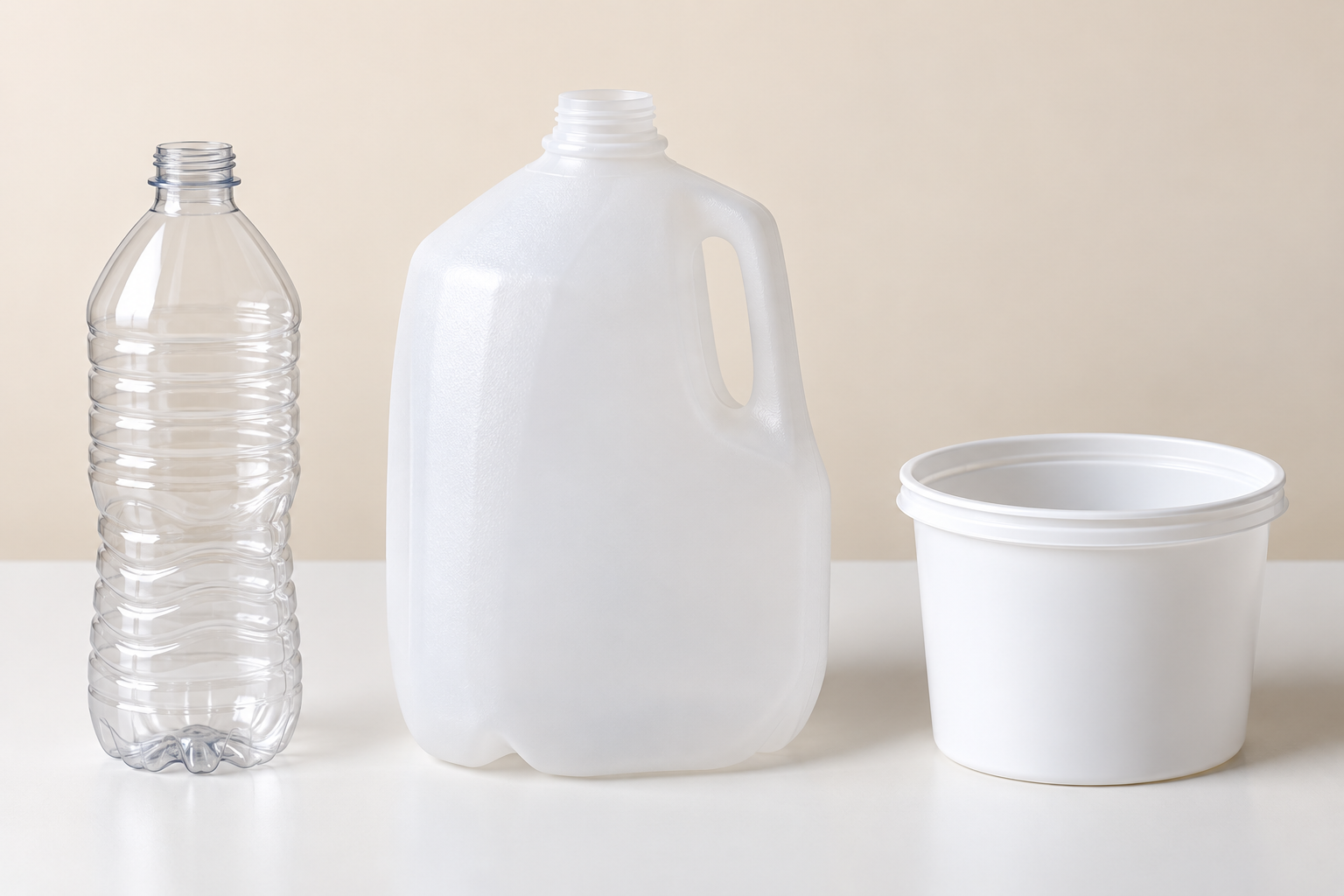
This is a good rule to teach everyone unpacking the kitchen. Put the local guide where the household makes the sorting decision, rather than expecting each person to remember what a previous town accepted. A quick shape check at the counter is easier than sorting the same mixed pile again at the curb.
Make the hazardous-waste trip a separate errand
The City lists the Household Hazardous Waste Facility at 1055 A Cleaner Way, Huntsville, AL 35805, with weekday hours of 7 a.m. to 5 p.m. Its facility page identifies electronics, automotive fluids, household chemicals, paints and solvents, batteries and other named categories. Use that facility address—not a sanitation-office address from a website footer.
The City’s September 2024 explanation of the service describes a free, appointment-free drive-through where staff collect items from the vehicle. It specifies Madison County residents, including Huntsville and Madison. If your home lies in a Limestone County portion of either city, confirm eligibility directly rather than assuming RANA’s broader curbside boundary also establishes the drop-off boundary. Business waste is not established as eligible by these residential sources.
Call 256-882-0155 before setting off with an unidentified, leaking or otherwise unusual item, and ask what preparation the facility requires. Its published exclusions include explosives and radioactive or biological waste. Do not load a mystery substance simply because the facility accepts many familiar household products. Check current operating information before the trip, especially around holidays; the listed weekday hours are not a holiday guarantee.
Give batteries their own decision
A battery that fits in a familiar device is not necessarily the same chemistry as the one it replaced. EPA’s household-battery guidance says to use labeling to identify the type. Lithium and rechargeable batteries do not belong in household trash or municipal recycling bins because of fire risks.
For removable batteries, EPA describes nonconductive tape over the terminals or individual plastic bags to prevent contact. Do not interpret that as permission to pry a built-in battery out of a device. For a damaged battery, EPA directs consumers to the manufacturer for specific handling information; resolve that before treating it as a routine drop-off. The local facility lists household and car batteries, but the item’s condition still matters when arranging safe handling.
Build the first-month routine around the actual collection day
Imagine the first weekend after possession: flattened delivery boxes, rinsed drink bottles, one glass jar and an old paint can. The boxes and eligible bottles belong in the RANA plan once service is established. The jar stays out of that cart. The paint belongs in the separate HHW decision, not tucked under cardboard to get it out of the way. You have now reduced one messy pile to a few clear next actions.
Save your assigned monthly collection day and set a reminder for the evening before. RANA says carts should be out by 7 a.m. on collection day. Check the operator’s current homepage alert before assuming a missed pickup: when this guide was researched on October 26, 2026, RANA was posting a temporary revised collection sequence. That dated exception is why a screenshot of an old calendar is a poor substitute for the current RANA update. Follow the current alert’s reporting instructions if it changes your route.
If you are moving from Decatur as well as into the Huntsville area, keep the two services separate. The Decatur moving-cleanup guide addresses the departure side, including bulky items and repair debris. This guide addresses the new household’s routine; neither city’s rules should be carried across the move unchanged.
Conclusion: learn the local routine once
The win is not a perfectly sorted garage on moving day. It is knowing which household service you actually have, recognizing the containers that belong in its cart, and giving hazardous items their own route. Set up those decisions early and the next round of boxes, batteries and cleaning supplies becomes much easier to manage.
Want Personalized Real Estate Help?
When you are comparing homes in Greater Huntsville, the everyday setup matters alongside the house itself. I can help you organize the housing and relocation questions that make a move feel manageable, while the service providers confirm the collection details for your address. Contact me to talk through buying, selling or settling into your next Northern Alabama home.
Still deciding where to settle? Browse homes in Huntsville and the surrounding area then confirm collection services for each address on your shortlist.
Sharing is Caring:
Author