
A first camping weekend can be a lovely way to get to know Winston County after a move. But “a campsite on Smith Lake” is not a complete plan. A tent, a rented travel trailer and a larger RV need different things, and two sites with the same reservation label may not offer the same setup.
Clear Creek and Corinth give you two developed-campground options to compare. Start with your equipment and the people coming with you, then choose a site and date. The practical goal is to arrive knowing where the equipment fits, which connections you have and what needs to happen before the entrance office closes—not to discover those details after a long drive.
Jump to the hookup comparison, individual-site examples or arrival plan. This is a camping-planning guide, not a report of available reservations.
Compare the setup before comparing the view
The Forest Service Clear Creek description and Corinth description make a useful distinction that the lake name alone cannot tell you:
| Option | Published arrangement | What it changes |
|---|---|---|
| Clear Creek developed campsites | Water and electricity, with a separate dump station. | Plan the wastewater part of an RV stay separately from the water and electric connections; do not assume an individual sewer hookup. |
| Corinth developed loops | Electrical, water and sewer hookups in the two developed camping loops. | If an individual sewer connection matters to your equipment and stay, investigate these sites first. |
| Corinth rustic tent sites | Eight rustic tent sites with nearby community hydrants and a bathhouse. | This is a different setup from an RV full-hookup site. Check the individual tent-site description rather than applying the developed-loop amenities to it. |
For a rented trailer, give the rental provider the exact site record, not just the campground name. Ask what equipment and connections the unit requires and which setup tasks you are responsible for. This guide is not an instruction manual for electrical or wastewater connections; use the equipment provider’s instructions and the campground’s rules.
There is one source mismatch worth settling before relying on water availability: Corinth’s Forest Service page describes water hookups and community hydrants, but its separate amenity field says potable water is unavailable. The booking overview also describes drinking water. Those pages do not establish whether the short field reflects a temporary interruption or a content error. Ask the operator about water for your site and dates; do not interpret the conflict as either a confirmed outage or a guarantee of supply.
Read the individual site record: the category is not the whole answer
Two examples show what to examine. They are examples of published specifications, not recommendations that either site is currently vacant or suitable for your vehicle.
Clear Creek Site 50 in Hoot Owl is listed as a paved, back-in standard-electric site for up to six people and two vehicles, with an RV maximum length of 53 feet. Its individual reservation page also lists water and a 50-amp electrical field. The length figure belongs to this specific record; it does not establish the limit for every Clear Creek site or prove a particular combined tow vehicle and trailer arrangement fits.
Corinth Site 11 in Yellow Hammer is also labeled standard electric and back-in, with a six-person and two-vehicle limit. Yet the individual page leaves its maximum-vehicle-length field blank. A number displayed under driveway length is not a substitute for a stated equipment limit. If your setup depends on a particular size, get the missing answer from the operator instead of treating an empty field as unlimited space.
For your shortlist, retain the site number and loop, permitted equipment, stated maximum length, entry type, people and vehicle limits, and required hookups. Then compare those fields with your actual setup. Count the people and vehicles in the plan you intend to bring, including friends joining you, rather than the simpler version that would fit the booking form.
Back-in and pull-through are physical differences
Clear Creek lists some pull-through sites, but Site 50 is explicitly back-in. A back-in space generally branches from the campground road and requires reversing into it. A pull-through has separate entry and exit connections. For someone new to towing, those words can matter more than whether a listing says the site is spacious.
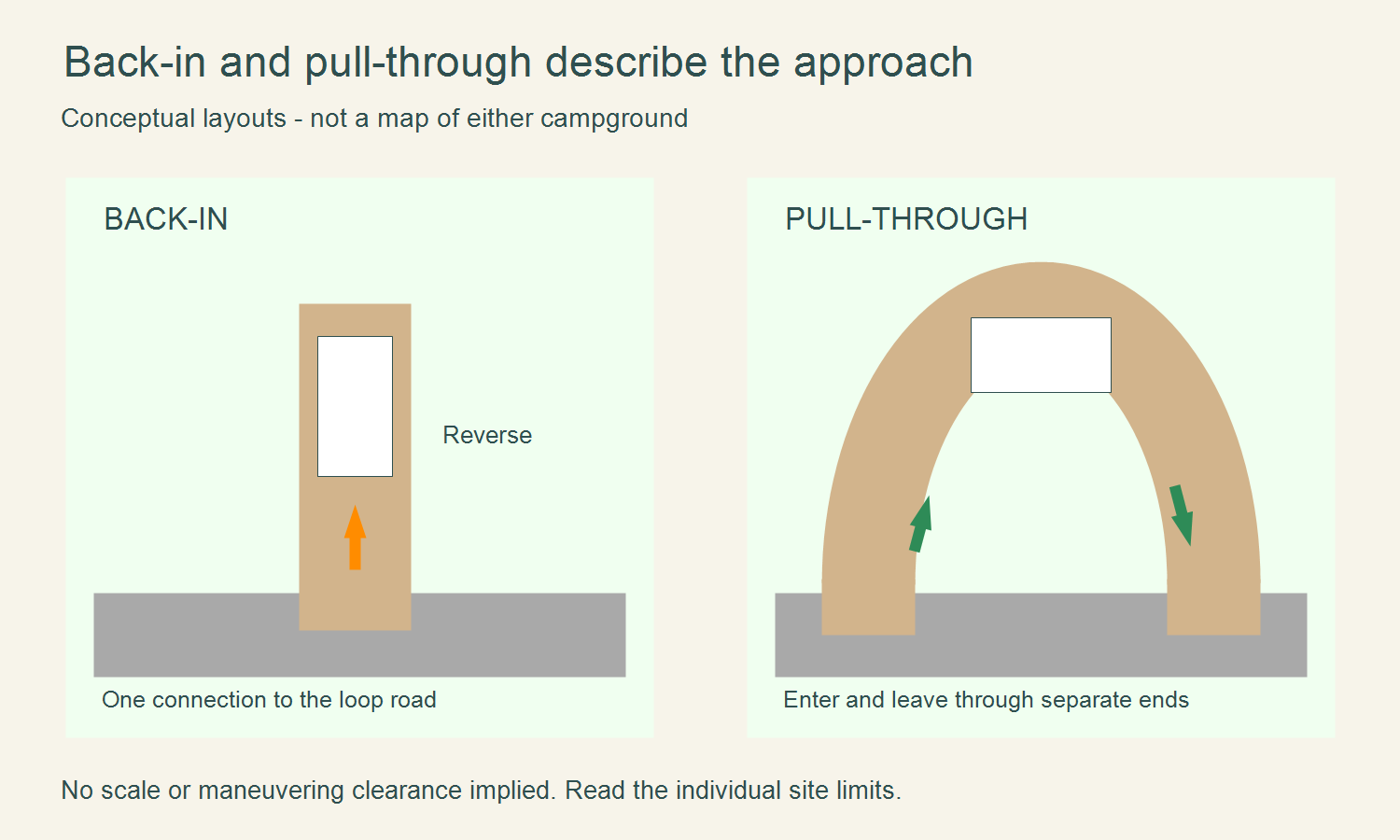
The diagram shows the idea, not either campground’s geometry or a maneuvering instruction. A pull-through label does not tell you turning radius, grade, overhead clearance or whether you can leave your tow vehicle attached. Read the site details and photos, and ask the operator about anything your equipment depends on. If you are inexperienced with that vehicle, practice with appropriate instruction before the trip; a reserved site is not the place to learn by blocking the loop road.
Match the whole party, not just the RV
Clear Creek’s booking instructions limit a single site to six people and two vehicles; a double site allows twelve people and four vehicles. The operator’s booking instructions also specify tent combinations and keeping tents on the pad. A larger party should choose the appropriate reservation, not assume an extra tent can be tucked into the surrounding woods.
Consider two adults and two children with one trailer and one tow vehicle. Their four-person count is below the published single-site limit, but that alone does not select the site: trailer fit, permitted equipment and the actual parking arrangement still matter. If another household joins with its own vehicle and tent, recalculate the full setup before booking. Do not treat overflow parking as extra sleeping space or a way around occupancy limits.
The same principle helps when inviting local friends to visit your campsite. Registered campers, overnight occupants and daytime visitors may be handled differently. The Clear Creek operator publishes separate visitor and extra-vehicle instructions; read those with your guests before arrival so everyone knows where to park and whether an additional charge applies.
Build an arrival plan around the reservation
Camping at both Clear Creek and Corinth is reservation-only, according to their Forest Service pages. Use the Clear Creek booking page or Corinth booking page to select the actual dates and site. A search result describing a campground is not a reservation, and the examples above are not an availability check.
Clear Creek tells registered campers needing after-hours access to call ahead at 205-300-1463. Do that before the travel day if your arrival may be late. Do not count on an electronic gate opening simply because you have a campsite number. Save your confirmation and operator instructions somewhere you can retrieve them without relying on a signal at the entrance.
Both campground descriptions list check-in no earlier than 2 p.m. and checkout by noon. If you are combining a showing day with the trip, leave room between the appointment and campsite arrival instead of assuming you can occupy the site early. A delayed handoff is easier to manage when the campground has not become your only place to wait.
Separate your camping dates from the lake’s year-round appeal
As checked October 27, 2026, the Forest Service pages give an October 31 end to the general camping season while separately describing year-round boat ramps. That does not make the campgrounds year-round overnight accommodation. It also does not establish next year’s opening dates; use the next published calendar and actual reservation availability for a future-season trip.
Clear Creek’s booking page currently says the swim area is closed for the season. If swimming was the reason for choosing the trip, that changes the plan now. Do not let an activity list showing “swimming” override a specific closure notice. A fall camping visit and a summer beach day are different outings, even at the same recreation area.
Keep the scope of this visit clear when you are considering a move. A pleasant campsite can introduce you to the lake, but it cannot establish access rights from a home or the practical route from a property to your chosen facility. My Double Springs and Bankhead home-search guide covers that next set of questions, including public roads, private land and recreation access. Use the camping visit to learn what you enjoy, then examine a potential home on its own merits.
Operator and Forest Service information checked October 27, 2026. No reservation, current vacancy or 2027 opening date is represented here. The featured image is an AI-generated fictional camping scene; the inline diagram is conceptual, not a campground map.
Conclusion: choose the site for the trip you are actually bringing
For a first Smith Lake overnight stay, start with the equipment and party, compare hookups, and read the individual site record before reserving. Clear Creek and Corinth offer different arrangements; neither a broad campground label nor a scenic photograph answers every practical question.
Once the site fits, settle the arrival instructions and seasonal activity plan. That leaves more of the weekend for getting acquainted with Winston County, and less of it for solving avoidable setup surprises.
Want Personalized Real Estate Help?
If lake outings are part of the life you want in Winston County, connect that preference with the places you would use from an actual home. I can help you organize a purchase, sale or relocation around those everyday priorities. Contact me to discuss your plans and the property questions that deserve a closer look.
Explore homes around Double Springs as one Winston County starting point. This search covers Double Springs and its surrounding map area toward Houston; it is not all of Smith Lake, a waterfront filter or a guarantee of access to either campground.
Sharing is Caring:
Author