
You have found a house you can picture coming home to, and the inspection calendar is filling up. Radon testing can feel like one more appointment to fit in. The useful question is bigger than whether a device can sit in the house for a couple of days: will the testing plan give you the information you need before your decision deadline, and what should happen after you move?
For Northern Alabama buyers and sellers, that second question deserves attention. A transaction test and a year-long follow-up serve different purposes. You can plan for both without treating a radon result as either a reason to panic or a permanent all-clear.
Why a North Alabama address deserves its own test
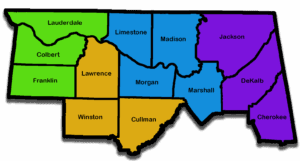
ADPH identifies Colbert, Franklin, Jackson, Lauderdale, Lawrence, Limestone, Madison and Morgan among Alabama’s counties with the highest potential for elevated radon. Those are eight counties within this site’s Northern Alabama coverage, but the list is not a way to clear a particular home. ADPH recommends testing all homes because levels can differ substantially even between neighboring houses. See its Alabama radon overview.
There is a local wrinkle behind the need for follow-up. ADPH says North Alabama has many karst formations, where dissolved rock and underground openings can contribute to highly variable radon levels. Its karst testing guidance explains that seasonal changes can produce different results and recommends a year-long test for the clearest picture. Do not infer the geology under a house from its mailing address; bring that property question to a qualified tester or the Alabama Radon Program.
This is a property investigation, not a neighborhood ranking. A county label, an attractive interior or a reassuring result from another address cannot substitute for the measurement in the home you are considering.
Match the test to the decision you need to make
The EPA Home Buyer’s and Seller’s Guide, revised March 2024 distinguishes short-term testing from longer measurement. Short-term tests run from two to 90 days, depending on the device; long-term tests run for more than 90 days and better represent the year-round average. A short transaction window explains the need for a quicker method. It does not make that method a full-year measurement.
| Your situation | Useful testing route | What belongs on the calendar |
|---|---|---|
| A purchase decision needs results quickly | EPA describes two simultaneous passive tests, two sequential passive tests, or a continuous monitor. Each measurement runs at least 48 hours. | Setup, required conditions, measurement, report delivery and time to discuss the result. |
| You have moved in after relying on a short test | ADPH’s karst transaction guidance calls for a 12-month confirmatory test immediately or soon after moving. | A start date, the device’s full measurement period and a reminder to return it or review the result. |
| An older report tested a different living level | EPA identifies a change in occupied level as a reason to retest that level. | Testing that matches the space you intend to use. |
The follow-up in the table comes from ADPH’s karst real-estate instructions; the changed-living-space advice comes from EPA’s retesting guidance. A qualified tester can connect the appropriate protocol to the property and your deadline. Ask for the expected report-delivery date, not just the date the device will be collected.
For example, if a hypothetical inspection period ends Friday, a device collected Friday afternoon does not leave much room to read a report, obtain a mitigation proposal or discuss an agreement. Work backward from the decision date when booking. The contract controls the actual deadlines and responsibilities; a testing appointment does not extend them.
Protect the test conditions, not just the appointment
ADPH’s karst transaction instructions call for closed-house conditions for at least 12 hours before testing and warn against testing during severe storms or high winds. Coordinate the visit with the occupant so the house can meet the tester’s instructions. Normal entry and exit is different from leaving exterior doors open while movers or contractors work.
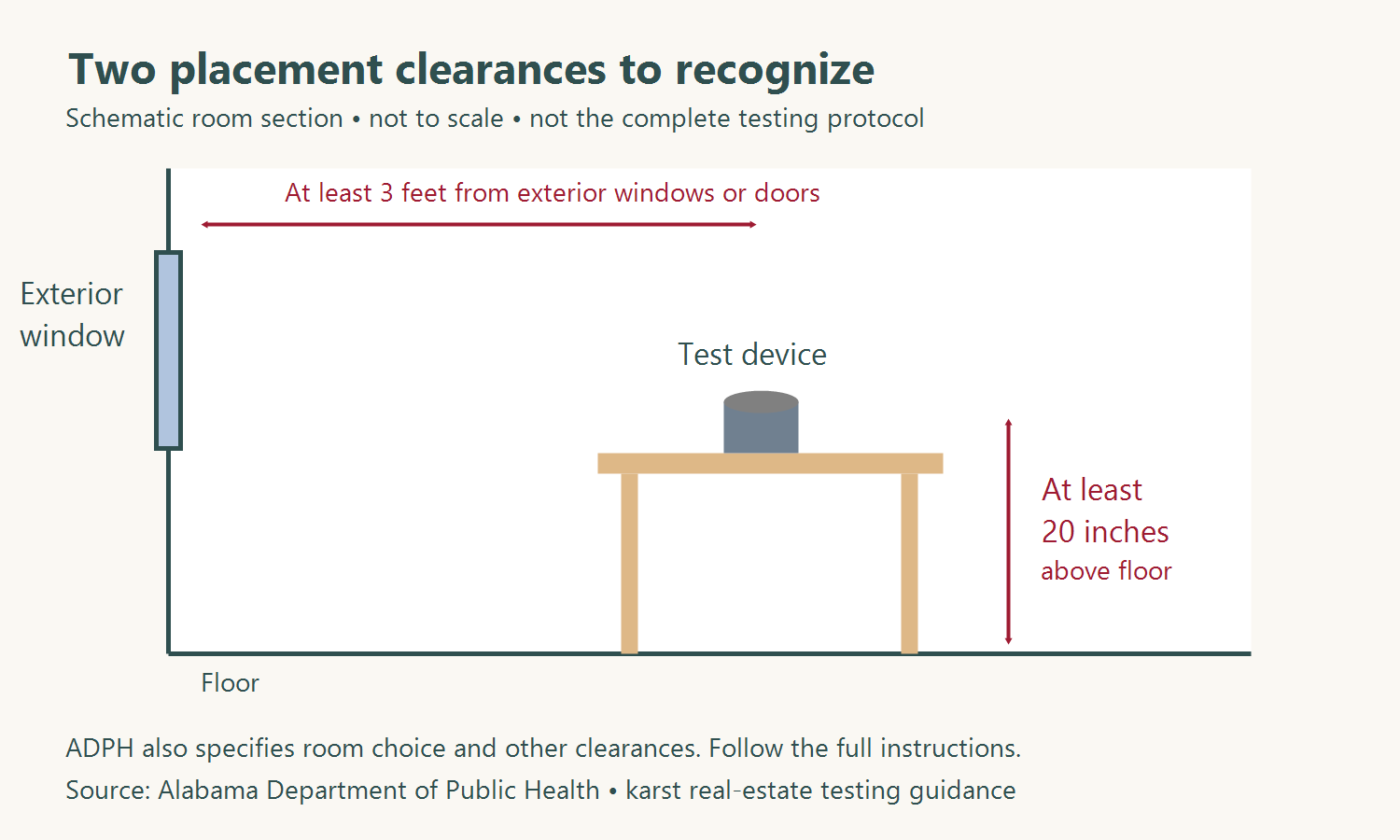
The device is measuring indoor air, so its position matters. The illustration below shows two of ADPH’s placement clearances; it is not a complete setup protocol. The provider’s equipment instructions and the full ADPH placement guidance control the actual test. Let the tester select the room and position, and leave the device where it was placed.
A house still needs to function during the appointment. Tell the tester about planned deliveries, work in the test room or a change in the weather before the measurement starts. If conditions are disturbed, report what happened rather than trying to repair the result by moving the device or quietly restarting a timer.
Read the number as an action point
EPA recommends fixing a home at 4 pCi/L or above and considering reduction between 2 and 4 pCi/L. The unit, picocuries per liter, describes radon concentration. EPA does not describe 4 pCi/L as a boundary between harmless and harmful exposure. Its action-level explanation is more useful than a simple pass/fail label.
A buyer receiving a result near the action level needs the report’s method, duration and interpretation, not a rounded number in a text message. Keep the actual report with the transaction records. The next conversation should identify whether additional measurement or mitigation is recommended, who will arrange it, and how completion will be documented. Do not use a future long-term test as a reason to ignore a current result requiring action.
ADPH recommends a trained radon contractor, more than one estimate and testing again after mitigation to verify reduction. Its mitigation overview describes systems that remove soil gas before it enters the home, with the design depending on the building. A visible pipe or fan is not itself the follow-up measurement.
For a house that already has a system, collect the installation and service information along with the latest test result. Make the handoff concrete: where the documentation is, who services the equipment, and what the provider says to do if its indicator changes. This is a better starting point than assuming the presence of equipment settles the question.
An old report and a new house both need context
EPA says a buyer may request a new test when an earlier test is not recent, the home has changed, or the buyer will use a lower level than the one tested. Imagine turning a lower-level room into your everyday office after the seller used it only for storage. That planned use belongs in the testing conversation before you arrange the desk and moving boxes.
EPA recommends testing newly built homes after occupancy even when radon-resistant features were installed. Ask the builder what was included and obtain the documentation. EPA’s new-home guidance distinguishes construction features from the testing that shows how the finished home performs. “New” and “tested” answer different questions.
As you collect these records, keep each inspection subject separate. For the related pest-inspection question, the North Alabama termite paperwork guide explains why an inspection report, treatment history and continuing coverage are different documents. Neither those records nor a radon report should be asked to answer a question it was not designed to address.
Where Alabama residents can start
The ADPH radon-testing page links to testing instructions and NRPP and NRSB provider directories. For a time-sensitive sale, use those resources to find a qualified provider and confirm availability and report timing. This article does not endorse a contractor or establish a provider’s current credentials.
As checked October 27, 2026, ADPH’s online request form offers a free test kit for Alabama households and states that return shipping is not included. The actual kit-request form requires a physical shipping address rather than a post-office box. Read its current terms before ordering. An available form does not establish stock, delivery time or suitability for your transaction deadline; no order was placed to verify fulfillment.
If you are selling, gathering the existing report and system records before the inspection period helps make the conversation orderly. If you are already an owner, choosing a start date and a follow-up reminder turns a good intention into a test that gets finished.
Conclusion
A useful radon plan has two clocks: the decision deadline for the house and the measurement period that helps you understand living in it. Give the transaction test appropriate conditions, read the actual result, address recommended action and keep the longer-term follow-up on your calendar. That approach lets you make a North Alabama housing decision with evidence tied to the property rather than a county color, a neighbor’s experience or an old reassurance.
Sources checked October 27, 2026. EPA’s transaction guide is the March 2024 revision; ADPH’s karst transaction page was updated September 17, 2024. Guidance and program availability can change. The featured image is a conceptual AI illustration, not a photographed property or a testing setup.
Want Personalized Real Estate Help?
If you are buying, selling or relocating in Northern Alabama, I can help you organize the property questions and timing that belong in your move. Contact me to talk through your next step and where professional inspection findings fit into the homebuying process.
Sharing is Caring:
Author