
An older home can have fresh paint, updated appliances and a small white alarm that has been on the ceiling longer than anyone remembers. When you are preparing to move in, the useful question is not simply whether you spotted an alarm. It is whether the right devices cover the way you will use the house, whether their age is known, and whether you have a workable maintenance plan.
For a Northern Alabama purchase, I would put that conversation alongside the inspection paperwork rather than leave it for the first night with boxes everywhere. You do not need to become a fire-protection specialist. You do need a clear handoff: which alarms are there, what they detect, what needs attention, and who will complete it.
Start with the rooms people will actually sleep in
The U.S. Fire Administration recommends smoke alarms in every bedroom, outside each separate sleeping area and on every level, including the basement. Its smoke-alarm guidance also recommends interconnected alarms, so one sounding activates the others. Those are coverage principles to discuss for the actual floor plan, not a universal shopping count.
Walk the house in the order your household will use it. Mark the bedrooms, the hall or space serving each sleeping area, and each level. A bedroom at the opposite end of a house deserves its own entry on your sketch; do not let a single checkmark labeled “hall alarm” stand in for the whole layout. Likewise, a finished lower level should not disappear from the list because the listing photographs concentrate on the main floor.
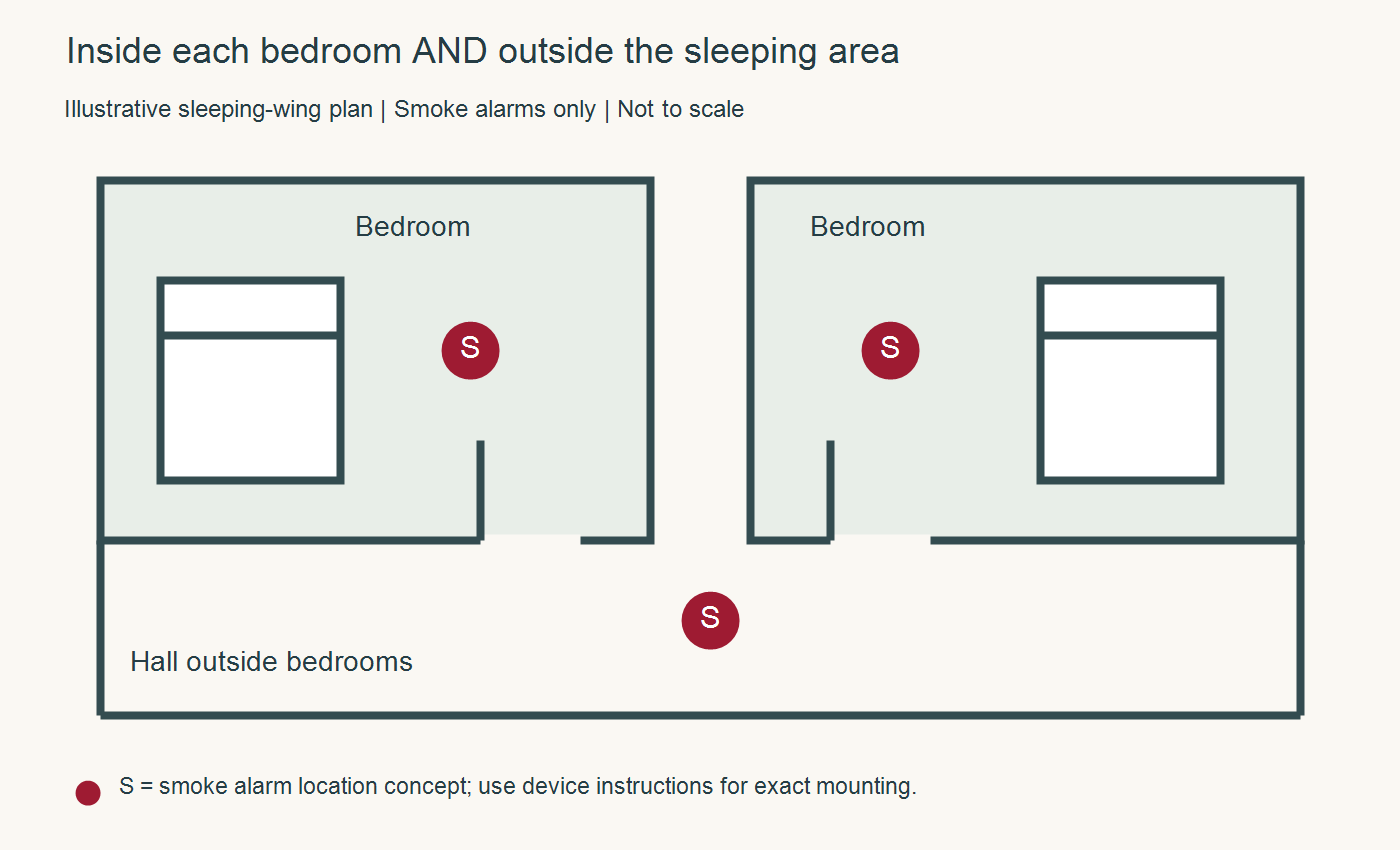
In the illustration, the hall device and the two bedroom devices serve different locations. It is deliberately a small part of a home, not a design you can copy onto any house. Doorways, separate sleeping wings, additional floors and the particular alarm all affect the conversation with your installer or fire department.
USFA says to follow the manufacturer’s placement instructions and have a qualified electrician install hardwired smoke alarms. Use the sketch to identify questions, not to improvise wiring or choose an exact mounting point from a generic picture. Local requirements may specify an alarm type; USFA directs residents to the local fire marshal for that determination.
Read the device, not just its shape
Photograph the model information and dates when they can be viewed safely, or ask the inspector or installer to document them. Do not remove a hardwired unit or climb unsafely just to complete your list. An unreadable label is an unresolved item, not a reason to guess.
Alabama’s State Fire Marshal guidance says to replace a smoke alarm after 10 years, sooner if it does not respond properly during testing, and to replace it if its age is unknown. The dated Alabama guidance points to the manufacturing date on the back or side. The date you bought the house does not reset that clock.
| What you find | What to record | What it changes |
|---|---|---|
| A clearly identified smoke alarm | Model, manufacture date, power type and test instructions | You can plan its replacement and maintenance instead of starting from an unknown age. |
| A smoke/CO combination unit | Both detection functions and the model’s replacement instructions | You need to account for both functions; its appearance alone does not settle where other devices are needed. |
| An unidentified or unreadable device | Exact room and the missing information | Have the device identified and the gap resolved; do not mark the area protected based on a ceiling photograph. |
| A hardwired unit needing work | Installer assessment and completion documentation | Schedule qualified electrical work rather than treating it as an ordinary battery swap. |
This list also makes a seller-to-buyer handoff more useful. “Alarms checked” is less helpful than a dated record identifying the devices and what was done. Keep any agreed work within your actual transaction process; an article cannot establish who is responsible under your contract or certify that a property meets code.
Give carbon monoxide its own line on the list
CPSC recommends CO alarms outside sleeping areas, with battery operation or battery backup. Its carbon-monoxide information center addresses a different hazard from smoke. A household moving from a home with one heating arrangement to another should not assume that the familiar device layout transfers unchanged.
Record whether each device is labeled for smoke, CO or both. Then use the exact model instructions and a qualified professional to resolve placement for the house, especially unusual spaces. Do not simply copy the smoke-alarm sketch above and relabel the symbols as CO alarms. General summaries are not a substitute for the product’s mounting and location instructions.
The Alabama guidance says CO-alarm life expectancy varies by model and directs residents to the unit’s instructions for replacement timing. That is why the smoke-alarm age rule should not become an assumed lifespan for every CO device. Keep the two replacement decisions separate even if one combination product handles both functions.
Think of a buyer finding three devices of unknown age: one in the hall, one upstairs and one near an appliance. The next step is identification, not buying three identical replacements. The labels and floor plan may reveal missing coverage, different detection functions or a need for installation work. That example is a way to organize the review, not a finding about any particular home.
Turn the handoff into a routine you can keep
The Alabama State Fire Marshal recommends monthly testing of smoke and CO alarms. Save the instructions with your home records and set a reminder for the documented test procedure. Battery type matters: a replaceable-battery device and a sealed long-life unit do not have the same maintenance task. Follow the particular device’s instructions rather than opening a sealed unit or assuming every alarm needs an annual battery purchase.
If someone in the household may not hear a standard alarm, include that need in the installation discussion before moving day. USFA identifies alerting options that use flashing lights or vibration. A device that is present on the ceiling is only part of a plan that must work for the people living there.
If a smoke or CO alarm sounds, Alabama’s guidance is to leave promptly, call 911 or the fire department, and not go back inside. Know that response before a signal occurs. Use the instructions to learn routine maintenance signals in advance; do not use this article to diagnose an active alarm or remain indoors investigating it.
An Alabama route for installation help
Get Alarmed, Alabama! connects residents with participating fire departments that install smoke alarms in the home. The Alabama Fire College program page links its request form and says to contact the program manager if the local department has not responded within 14 business days. That is a follow-up instruction, not a promised installation date.
If you need help, start with that published route or your fire department’s nonemergency contact. Explain the address, the existing devices and any hearing or access needs. Do not assume the program supplies CO alarms, rewires a house or performs every requested service; the page describes a smoke-alarm installation program. Have the responsible provider confirm the assistance available for your home.
Once the alarm questions are organized, there are other move-in tasks that deserve their own evidence. My guide to purchase-time radon testing and follow-up explains a separate measurement timeline. A smoke or CO alarm does not replace that investigation, and a radon report does not establish fire-alarm coverage.
Final Thoughts
A useful alarm review ends with fewer unknowns: a floor plan marked by actual sleeping use, identified devices with dates and instructions, and a clear owner for any remaining installation work. It is a small piece of a move, but resolving it before the first night helps you begin using the home with a more organized plan.
Sources checked October 27, 2026. The Alabama Department of Insurance article is dated March 11, 2022; current federal guidance and the Alabama installation-program page were also reviewed. This is homeowner planning guidance, not an inspection or local code determination. Featured image: AI-generated conceptual illustration.
Want Personalized Real Estate Help?
If you are buying, selling or relocating in Northern Alabama, I can help you organize the property questions and professional follow-ups that belong in your move. Contact me to talk through your home search and transaction timing. Alarm placement is specific to the house and household; it is not a reason to label one community safer than another.
Sharing is Caring:
Author