
A bathroom outlet stops working in a home you have just bought. The obvious button is not necessarily beside it: protection can be provided elsewhere on the circuit. That is a useful detail to learn before the first morning when a familiar appliance appears to have failed.
This guide helps Northern Alabama buyers and homeowners recognize GFCI protection, perform the manufacturer’s normal user test and decide when to stop and call an electrician. It is not a wiring lesson or a finding that a particular house meets local code.
Recognize the device without assuming the whole circuit
GFCI means ground-fault circuit interrupter; you may also hear GFI. It responds to a difference between outgoing and returning electrical current, helping protect people from serious shock. ESFI’s overview explains why it is important where electricity and water can meet, including bathrooms, kitchens, garages and outdoors. Protection does not make wet electrical equipment safe to handle.
Look for the actual TEST and RESET labels on a receptacle. But no buttons on that particular face does not prove there is no protection. CPSC’s fact sheet describes GFCI breakers and receptacles that can also protect outlets farther along the circuit. Have the inspector or electrician identify which device serves an outlet when the relationship is unclear; do not remove plates or open a panel to trace it.
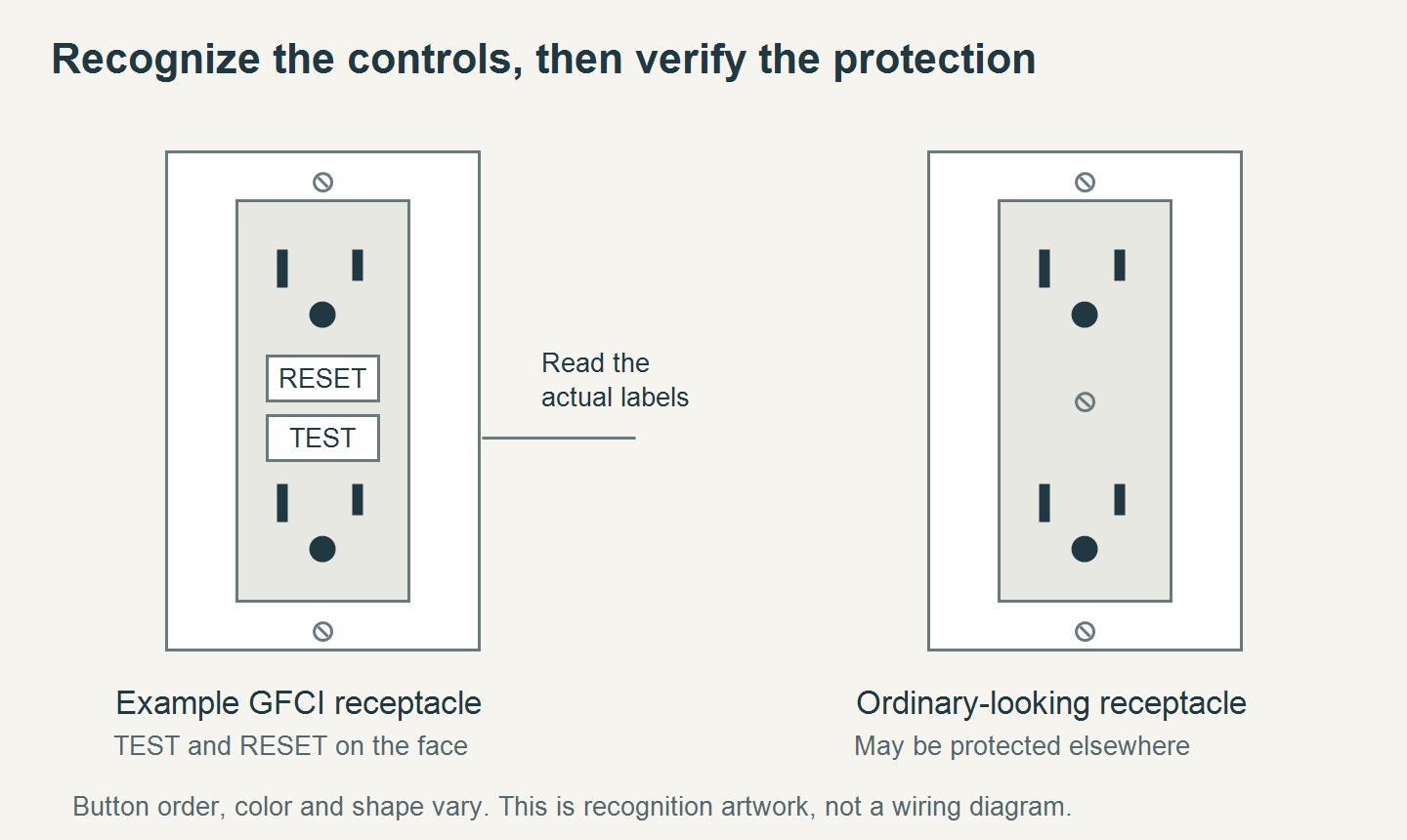
A useful possession note is specific: the outlet location, the protective device identified by the professional, its instructions and any unresolved finding. A photograph of a white wall plate alone answers none of those questions. The illustration shows the physical difference in controls, not proof of protection in a home.
Make the test observable
Use the instructions for the installed model. CPSC recommends testing after installation, at least monthly and after a power failure. Arrange the test when interrupting power is appropriate; first account for connected equipment that cannot safely lose power. If you cannot do that or cannot access the device safely, have a qualified professional handle the test.
For an intact, dry, safely accessible receptacle, Leviton’s homeowner test uses an operating lamp or radio: press TEST and observe that it turns off, then press RESET and observe that power returns. Follow your device’s instructions rather than guessing from the button position. Do not test damaged or wet equipment, or use yourself as a test of whether power is present.
The observation matters more than the click. A button moving does not establish that the receptacle stopped supplying power. Nor does a lamp that never came on establish a successful test. Note what happened at each stage so an electrician gets a useful description rather than “the outlet is bad.”
Use the result to choose the next step
| What you observe | What it means for your next step |
|---|---|
| The lamp starts on, turns off with TEST and returns with RESET. | You observed the normal user-test sequence. Record the date and keep the manufacturer’s maintenance schedule; this is not a whole-house inspection. |
| The lamp stays on after TEST. | Do not rely on the protection. Stop using the affected outlet and have a qualified electrician assess and correct it. |
| Power does not return with RESET, or the device repeatedly trips. | Stop trying to force a working result. Record the circumstances and arrange professional diagnosis rather than opening the device or repeatedly resetting it. |
| The outlet is dead before testing starts. | There is no valid on/off test result yet. Ask for the supply and protective-device relationship to be identified; do not call an unpowered lamp proof that GFCI protection works. |
Leviton explains that its SmartlockPro devices prevent reset when they cannot respond properly to a ground fault. It directs owners to a licensed electrician when a device fails its test. That is a reason to respect a failed reset, not a reason to defeat it. This article does not diagnose whether the device, connected equipment, wiring or supply is responsible.
Do not translate every light into the same diagnosis
Indicator meanings vary by product. In one Leviton self-test design, a green status light can remain lit while an amber light indicates the tripped state. The manufacturer still calls for a monthly manual test. Read the matching instructions before treating a green light as proof that the outlet is supplying power, or assuming “self-test” eliminates owner testing.
An AFCI is a different function. CPSC distinguishes arc-fault protection aimed at certain fire hazards from GFCI shock protection, and notes that combined devices exist. If a report says AFCI, GFCI or dual-function, keep those terms intact when asking for clarification. Do not substitute one familiar abbreviation for another.
Turn inspection findings into a useful handoff
The CPSC home electrical checklist identifies malfunctioning outlets, loose-fitting plugs and unusually warm outlets as issues needing attention. Stop using a suspect outlet until it is checked. A new cover plate does not resolve a finding about the device behind it; installation and repair belong with a qualified electrician.
For a buyer, carry the exact inspection finding into the follow-up: which room and outlet, what failed, who assessed it and what documentation shows completion. For a seller, keep the electrician’s invoice and the device instructions together rather than offering a blanket assurance that every outlet is fine. Keep access and agreed work within your transaction arrangements.
Once this electrical question is organized, give other move-in protection its own review. My older-home smoke and CO alarm plan explains device identification, coverage and replacement timing. A GFCI test does not answer those separate questions.
Final Thoughts
A useful GFCI handoff ends with identified controls, a documented normal test and a clear professional follow-up for anything unresolved. Learn the device you actually have, observe the result and stop at the boundary between user testing and electrical work. That makes the information more useful whether you are moving in, maintaining a home or preparing to sell.
Sources checked October 28, 2026. CPSC GFCI sheet carries a September 2010 footer; its AFCI sheet carries April 2012; its Home Electrical Safety Checklist is dated July 2008. Other linked guidance has no confirmed revision date in the retrieved text. These sources explain device operation, not the code adopted for a particular Alabama property. Hero: AI-generated conceptual illustration; inline recognition artwork is original.
Want Personalized Real Estate Help?
If you are buying, selling or relocating in Northern Alabama, I can help you organize inspection questions and professional follow-ups around your transaction timeline. Contact me to talk through the information you want in hand before possession. Electrical testing and repairs remain the qualified electrician’s role.
Sharing is Caring:
Author