Jessica Hassan
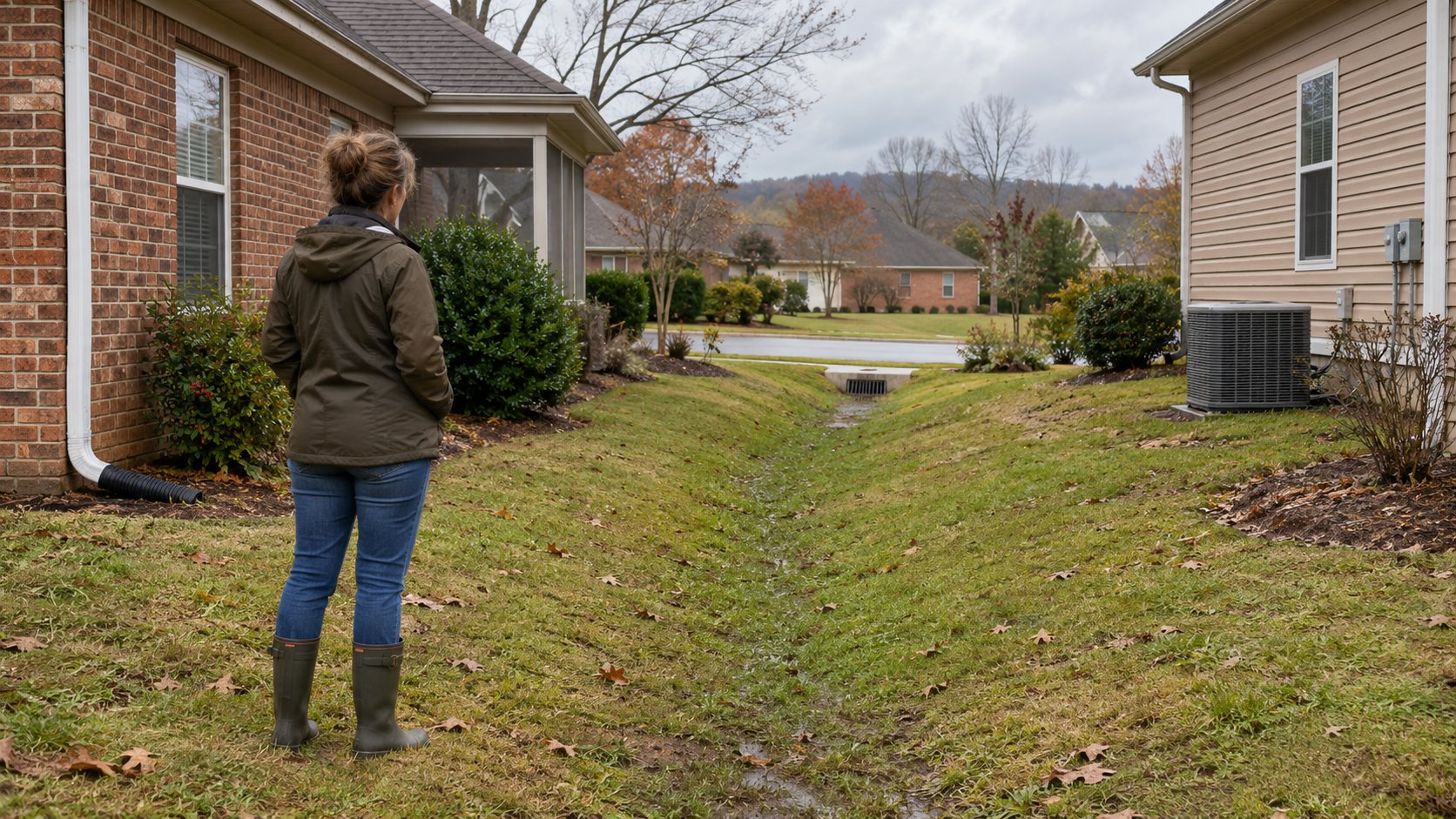
A wet strip behind a newly built house can point to several different questions: a lot-grading issue, runoff from work next door, a blocked public drain, or ordinary upkeep of a private ditch. The City of Madison routes these by the actual feature and construction stage, not by how new the house looks. Use its drainage and stormwater guidance and drainage FAQ to identify the first office to ask. Their general descriptions do not settle liability or an easement line for one address.
AI-generated generic drainage scene; it does not depict a Madison property, city easement, or reported incident.
First, identify the property and the water path
Confirm that the property is inside the City of Madison before applying these city routes; a Madison mailing address alone is not proof. Obtain the recorded subdivision plat or survey for the lot and mark the observed low channel, inlet, pipe or ditch on a copy. Ask whether a city drainage easement or maintained storm structure is involved. Do not infer a legal boundary from a wet patch or a map image.
Document what happens in one safe rain observation: where water enters, where it pools, where it leaves, and whether a drain looks obstructed. Date photographs from the same viewpoints. Note changes such as recent fill, a fence, new landscaping, or construction uphill. These records make a report more useful without asking a buyer to diagnose drainage engineering.
Use the city’s stage and feature routes
| What you observe | City’s published route | Record to ask for |
|---|---|---|
| Runoff from a large development still under construction | Engineering at (256) 772-5632 under the city drainage FAQ; the stormwater page also gives Engineering at (256) 797-8025 for drainage in new developments. | Development and drainage-plan status, plus the specific reported location. |
| Runoff from one unoccupied house still under construction | Building Department at (256) 772-5680 under the city drainage FAQ. | House permit and grading or final-inspection status. |
| Runoff from an occupied neighbor’s home after certificate of occupancy | The FAQ says this neighbor dispute is civil; describe any separate blockage or pollution concern to the city without promising an enforcement remedy. | Certificate status, dated observations, survey and professional assessment as needed. |
| Blocked inlet, culvert, closed drain or potential city easement | Public Works maintains the city storm system; call (256) 772-8490 to ask for an evaluation and confirmation of the maintained feature. | Recorded plat or survey and the city’s answer about the specific structure or easement. |
This is a routing table, not a promise of repair. The city’s Engineering Inspections page lists new residential grading, drainage and erosion-control inspections and sends new-home grading and certificate-of-occupancy inspection scheduling through the Building Department at (256) 772-5644. Separately, the drainage FAQ gives (256) 772-5680 for an unoccupied individual home under construction. Use the number attached to the specific question and confirm it with the office.
The Engineering page also mentions a two-year developer warranty inspection to release a developer. That is an inspection of subdivision development; it does not establish a universal two-year homeowner or builder warranty, a particular subdivision acceptance date, or responsibility for a wet spot on one lot. Ask Engineering for the actual acceptance and inspection record if that distinction matters.
A city easement and routine yard upkeep are separate questions
Public Works says it maintains the city storm drainage system, including bridges, culverts, closed storm drains and areas where the city has drainage easements. The same city page says the city is generally not responsible for routine maintenance of creeks, streams, ditches or drainage easements. Owners are asked to help maintain those areas because in most cases they remain private property. If flooding threatens property, the city says it will evaluate conditions and may trim vegetation when warranted.
So a recorded drainage easement is a reason to check the plat and ask what infrastructure the city maintains. It is not a mowing schedule, nor permission to fill a low channel. The city says depositing brush and trash in a ditch, stream or easement is illegal. For a blocked flow or suspected pollution problem, its guidance gives Code Enforcement at (256) 772-5644 or the “Let Us Know” route. For an evaluation of a ditch or easement, it gives Public Works at (256) 772-8490.
Build a three-record file before deciding on work
Keep (1) the recorded plat or current survey, (2) the home permit and certificate-of-occupancy status, and (3) the city’s written response identifying whether the feature is in its maintained system or a new-development review. The city’s public permit portal offers an address search without an account, but an absent result does not prove no permit or no city obligation. Ask the relevant office when a newer project has no assigned address or the result is unclear.
For example, a buyer sees a wet strip behind a new fence and a street inlet with debris. Treat them as two observations. The plat and survey help identify the strip; Public Works can evaluate the inlet or city-system question. If nearby construction is active, use the city FAQ to route a large development to Engineering or an unoccupied individual house to Building. Do not promise the seller, builder or city will fix either condition until those records and an appropriate inspection establish the facts.
Before regrading, redirecting a downspout, or adding fill across the flow path, ask the city whether a drainage easement or review applies. A qualified surveyor or drainage professional can address property-specific lines and remedies. If the issue is only the path of roof water, the separate North Alabama roof-runoff guide explains how to trace it; that guide cannot establish Madison’s easement or maintenance duties.
Conclusion
A wet yard deserves a precise question, not a guess about who owns all the water. Identify city jurisdiction, the construction stage, the recorded feature and the observed condition. Then use Madison’s published office routes to request the relevant record or inspection before agreeing to a repair, changing grade or making a purchase decision.
Want Personalized Real Estate Help?
If you are comparing Madison-area homes and a drainage feature raises questions, contact me. I can help organize property records and inspection questions while the city and qualified specialists address technical details. You can also browse a broad Madison-area home search; its results include nearby communities and cannot prove city jurisdiction or an easement for a listed home.
Sharing is Caring:
Author