
A winter afternoon in Decatur can introduce you to a very different side of Northern Alabama: a field full of cranes, binoculars at the ready, and a reason to slow down after weeks of moving decisions. Wheeler National Wildlife Refuge gives newcomers a way to learn the season through the wildlife around them. The trick is planning for the birds and the particular visitor facility, rather than treating the whole refuge as one always-open park.
For a first crane visit, start with the Visitor Center and nearby Observation Building. Then separate three questions: when cranes typically gather, when those facilities admit visitors, and which parts of the refuge are temporarily closed. Those answers do not all follow the same calendar. A new winter sanctuary closure makes that distinction especially useful for the 2026–2027 season.
Choose the season, without promising yourself a sighting
FWS describes late December and the first half of January as peak periods for waterfowl and cranes, while its sandhill-crane account says arrivals begin in late November and numbers peak in early January. That makes winter the useful planning window for this particular outing. It does not turn a date on the calendar into a reservation with the birds. The refuge seasonal wildlife guide is a better starting point than an undated photograph circulating online.
If you are visiting in October while looking at homes, enjoy what is there now and save the crane-focused return for winter. If out-of-town visitors are coming in January, leave some flexibility in the day instead of promising a particular flock size. An older record count cannot tell you how many birds will be visible from a window during your visit.
The featured photograph is a real Wheeler scene photographed January 4, 2024 by George Lee/USFWS: a mixed flock of sandhill and whooping cranes. It helps show the difference between gray and white birds in the same setting, but it is not a live view or a complete identification guide. View the agency photograph and public-domain credit. Ask staff or an experienced observer when identification is uncertain; there is no need to leave an approved viewing area to settle it.
Use the visitor-facility schedule, not simply daylight
The FWS visitor page lists March–October Visitor Center hours as Tuesday–Saturday, 9 a.m.–4 p.m., and November–February hours as seven days a week, 9 a.m.–5 p.m. It lists the Visitor Center buildings and grounds as closed on Thanksgiving Day, Christmas Day and New Year’s Day. These are local Central times. Check the operator’s current hours before setting out, especially for a holiday visit.
There is a useful caution here: the refuge Friends organization’s FAQ currently shows a narrower Tuesday–Saturday winter schedule. This guide follows FWS, the operator, but that discrepancy is a reason to confirm a Sunday or Monday plan directly at 256-350-6639. Do not choose whichever online hours happen to suit your itinerary.
The broader refuge visitor page welcomes recreation during daylight hours; that is not permission to enter closed Visitor Center grounds before opening or after closing. Likewise, an accessible road elsewhere on the refuge does not make every building or sanctuary available. Choose the facility first, then apply its schedule and posted notices.
A first-visit plan you can actually use
Set directions to the Visitor Center at 3121 Visitor Center Road, Decatur, AL 35603, not a generic pin somewhere inside the refuge. FWS recommends the Visitor Center and nearby Observation Building as the priority first stop. That gives you a practical place to ask what is being seen and where visitors may go that day.
FWS describes the Observation Building trail as beginning behind the Visitor Center, with a hard-packed crushed-stone surface and a small wooden footbridge; it identifies the trail and the building’s first floor as wheelchair accessible. The operator’s trail description gives you something more useful than a general accessibility label: a surface, a bridge and a specific floor. Call about current conditions and any particular assistance or sensory needs; those published details cannot answer every individual access question.
| Your plan | Make this choice before leaving |
|---|---|
| A short introduction | Start behind the Visitor Center and follow the Observation Building trail to the viewing pond; keep the visit within confirmed facility hours. |
| A crane-focused winter visit | Choose the seasonal window, bring binoculars if you have them, and ask about current sightings rather than relying on old counts. |
| A walk or bicycle ride as well | Check the current refuge map and closure notices for the exact route. Do not assume the bird-viewing destination and a recreational route have identical access. |
| A visit with mobility or sensory needs | Review the crushed-stone surface, wooden footbridge and first-floor access described by FWS; call about current conditions and your specific needs. |
You do not need an ambitious itinerary to find out whether this is an outing you would enjoy repeating after moving. Give the observation stop its own time. A quiet visit with a few good observations can be more satisfying than racing between distant access points to collect a larger list.
Know what the new winter sanctuary closes
FWS has announced a 335-acre seasonal waterfowl sanctuary from November 15, 2026 through February 28, 2027. The announcement closes a one-mile road stretch through the Buckeye–Thorsen Arm Unit between HGH Road and JTT Road to all public entry, while describing continued hiking and cycling access around the north side of the impoundment. This is a specific area restriction, not an announcement that the entire refuge or its Visitor Center closes for winter. Read the current refuge notices alongside the map below.
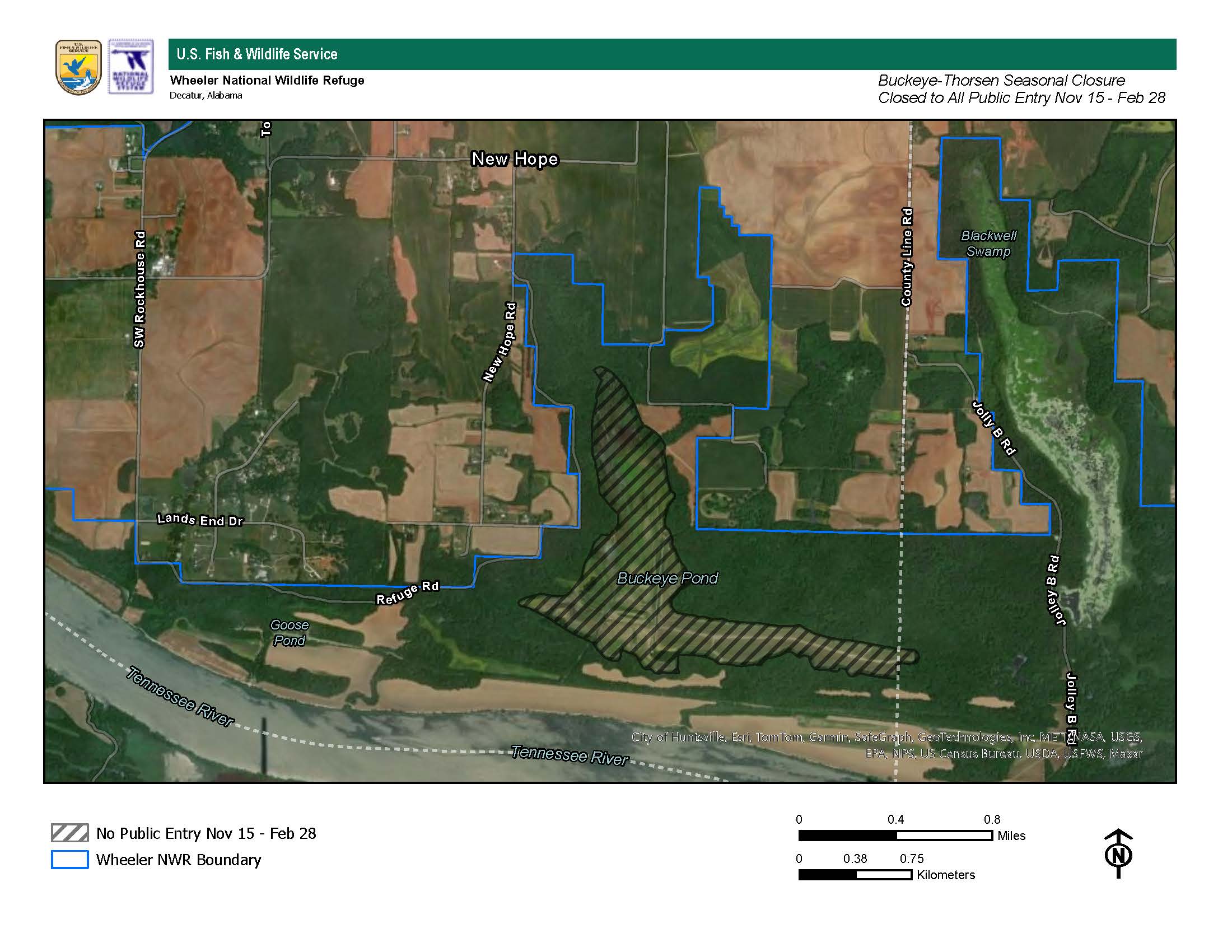
The hatching matters more than a familiar road name: it marks the protected area you must avoid. Keep the legend visible when saving the map, and open the full-size version to read its smaller labels. This is a closure map, not a new suggested walking loop, a property-boundary survey or permission to cross adjacent land. Follow current signs if conditions or restrictions change.
Bring the viewing closer, not yourself
Binoculars are useful because they let you examine the scene from where visitors belong. The refuge Friends FAQ advises staying on trails and out of closed areas because cranes are sensitive to disturbance. Watch from approved places, keep your group together, and avoid treating a camera lens as a reason to move into a field. The photograph above was selected to show real birds, not to suggest a viewing distance visitors should recreate.
Dress for the forecast. If Northern Alabama weather alerts are still unfamiliar, the guide to setting up weather alerts after a move explains the separate roles of phone alerts, weather radios and outdoor sirens. That is a useful move-in task beyond this one outing.
For a different kind of local outdoor day, compare the Guntersville city-walk and state-park options. That guide addresses route length and surface choices; Wheeler’s winter bird visit is about season, viewing conditions and protected habitat. They answer different questions about how you might spend free time in the region.
Final Thoughts
Start with a confirmed Visitor Center opening, a realistic seasonal expectation and the current closure notices. Bring curiosity rather than a promised bird count. As you get to know Decatur and the surrounding Tennessee Valley, small outings like this can reveal which seasonal routines you would genuinely look forward to—not just which attractions look appealing on a moving checklist.
Want Personalized Real Estate Help?
If you are weighing a move to Decatur or another Greater Huntsville community, tell me what you want your everyday life here to include. I can help you connect those priorities with your home search and the property questions worth answering before you decide.
Sharing is Caring:
Author