Jessica Hassan
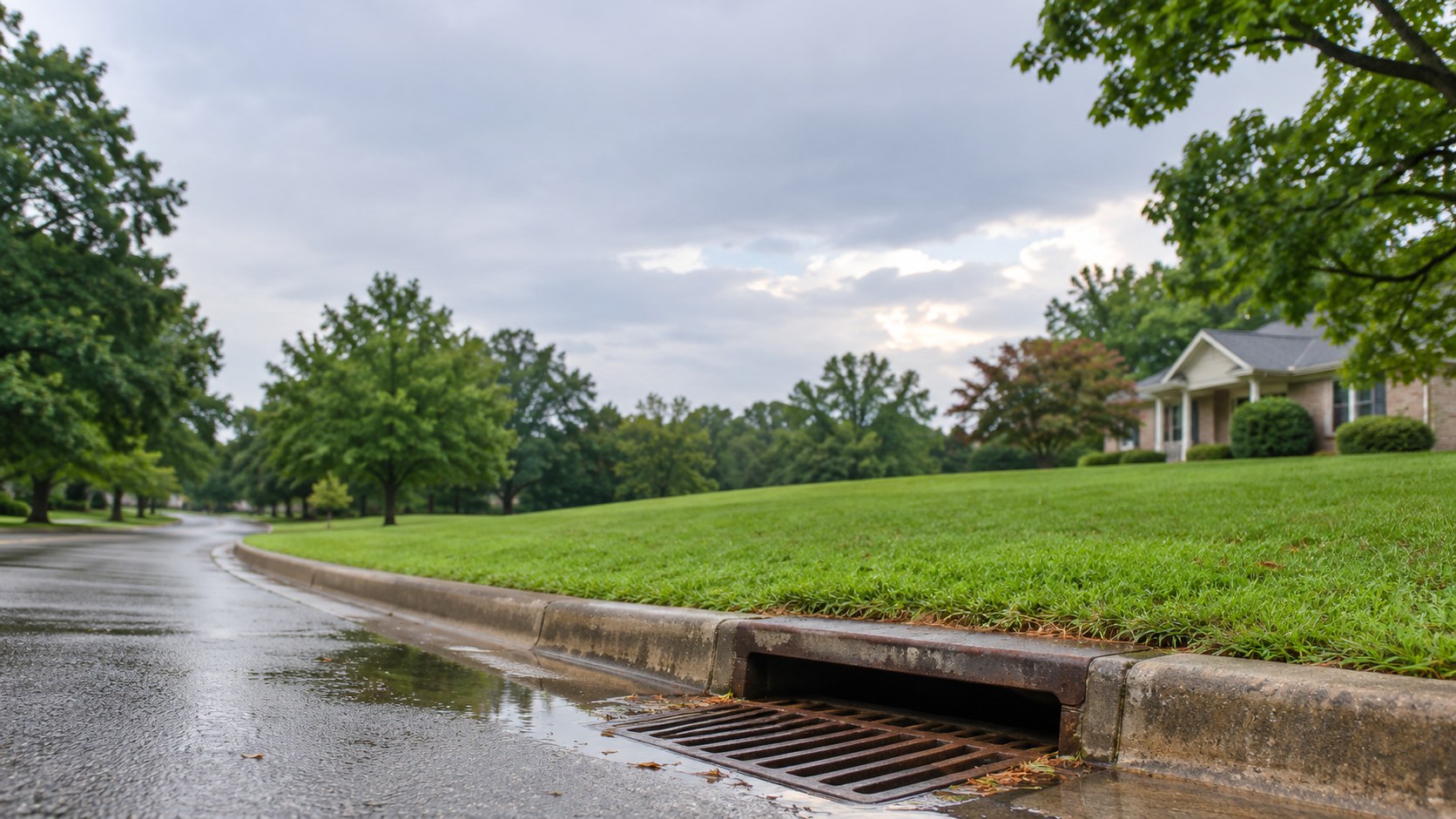
A storm leaves water pooled over a street catch basin and a separate strip of lawn wet beside a Florence house. Those observations can share a rainstorm without sharing one owner or one repair route. City Engineering says it handles drainage requests, but city work is limited to a public right-of-way or drainage easement. The first useful task is to locate the concern and describe what happened, then let the city determine its jurisdiction and whether the job is routine or needs a larger project. The featured image is an AI-generated generic curb scene, not a Florence street, actual city basin or property boundary.
A curb problem and a yard problem are different questions
Florence Engineering’s published drainage FAQ gives stopped-up catch basins and pipes as examples of routine service problems. A basin at the curb is therefore a sensible issue to report. The visible grate alone does not prove that every connected pipe, puddle or adjacent parcel is city-owned. Engineering says it will work only within a right-of-way or drainage easement. An easement may cross private land, so a wet spot inside a yard is not automatically outside the city’s work area; conversely, water coming from a public street does not by itself make every yard repair a municipal job.
Think of the physical route in three parts: where water enters, where it travels, and where it appears again. A blocked curb opening, a buried pipe crossing a recorded easement and runoff collecting in a private low spot would raise different questions. You can observe the first and last locations. You generally cannot establish pipe ownership, an easement boundary or the cause of a hidden blockage by looking at the surface. Ask the city which records and field inspection apply before assuming its crew or a private contractor should alter anything.
| What you see | First route to investigate | What remains unproved |
|---|---|---|
| Water stands at a street catch basin after rain | Report the specific basin and location to the city; ask Engineering whether it is within its system. | The report is not a finding that the basin or pipe needs a city repair. |
| Water crosses or collects in a private yard | Document the flow and ask whether a recorded drainage easement or public right-of-way covers the spot. | A wet yard alone does not establish easement limits or city responsibility. |
| Water leaves a downspout and returns toward the house | Investigate the home’s roof-water route with a qualified drainage professional. | A city drainage report does not diagnose or repair the private outlet. |
This table is a sorting aid, not a property survey. The city FAQ explicitly assigns drainage problems on private property to the property owner and limits city work to the right-of-way or an easement. The middle row is deliberately a records question: the existence and scope of an easement on one parcel must be checked, not inferred from a puddle. The last row is explained in more detail in my North Alabama roof-runoff guide, which follows water from the downspout to its outlet rather than assigning municipal ownership.
Report the condition so Engineering can locate it
The city’s Report an Issue form offers “Storm Drain Issue/Blocked Drain,” “Flooding” and “Catch Basins” as issue choices under its street and sidewalk route. It requests a detailed description and a specific location or reference point, with an optional photo. A useful report says which curb opening or yard edge you saw, the nearest address or intersection, when rain stopped, how long water remained, and whether the same area has been affected before. Take photos from a safe place after the weather clears. Avoid entering floodwater, lifting a grate or asserting that an unseen pipe failed.
For a boundary, easement or complex-drainage question, the Engineering Department page lists 256-760-6350. Explain whether you are asking the city to inspect a reported street condition or to identify what records define its work area. The form is an intake route, not a city decision or a repair promise. Keep the submitted description and any response so a later conversation refers to the same location. For an immediate hazard, use the appropriate emergency route rather than waiting for a routine web form.
Routine service and the city drainage list are separate tracks
Engineering says many drainage requests are routine, including stopped-up catch basins and pipes, and that it addresses those as received. That wording does not promise a same-day repair or mean every report will be classified as routine. If an evaluated problem requires extensive work, the city places it on its Drainage List. Engineering assigns a grade from 1 to 7; the lower number means a more serious problem and a higher place on the list.
The grade describes priority, not a construction date, budget approval or guarantee that the city will take work onto private property. If a complaint becomes a larger project, ask what problem was evaluated, whether it is on the list, what area the city can legally work in, and what additional design or funding steps remain. A resident can then distinguish “we received your blocked-basin request” from “this project has been graded” without treating either as completed drainage relief.
Keep property records separate from a flood-zone answer
For a home purchase, save the visible-condition photos, any city request and response, survey or recorded easement documents, and any seller or contractor drainage records. A survey may show a recorded easement; it still needs interpretation for the actual planned work and city practice. If an owner proposes work in a right-of-way or easement, the FAQ says a city permit is required for opening, repairing or modifying it and that the work must be done by a licensed contractor. Contact Engineering before arranging work there, rather than treating a private fix as permission to modify public drainage.
A mapped flood-hazard question is another record set. My Florence-area flood-map guide explains how to identify the actual parcel, structure and effective map. An unmapped yard drainage concern can still matter, and a flood-zone label alone does not diagnose a blocked catch basin. Keep the city service request, property easement review and flood-map check as separate lines in the home file.
Conclusion
Report a blocked street catch basin with a precise location; ask Engineering to determine whether the issue is routine and within the city’s work area. For water in a yard, first establish whether the relevant ground is private, public right-of-way or a recorded drainage easement. If the city says extensive work is needed, its 1-to-7 grade is a priority signal, not a completion date. Those distinctions help a Florence homeowner follow up with the right question and avoid promising a fix that no public page guarantees.
Want Personalized Real Estate Help?
If you are comparing Florence-area homes, contact me and I can help organize the property-specific drainage, survey and inspection questions within your home search. You can also browse Florence-area homes as a starting point. Listings and map results can include nearby communities and cannot establish city drainage responsibility, an easement boundary or a property’s flood status; confirm each address and record separately.
Sharing is Caring:
Author