
A renovation estimate can look complete until the debris has nowhere to go. If you are planning a project at a Scottsboro home, the city’s roll-off program gives you a useful option to price—but the container size is only one part of the decision. Material acceptance, calendar-month rent, disposal weight and the removal date all belong in the same plan.
A roll-off is a large open-top container delivered and removed by a truck. This guide explains the city’s published paperwork so you can compare a project allowance with a real quote, rather than treating a monthly rental figure as the whole bill.
Start with the material, then choose the size
Scottsboro offers 20-, 30- and 40-yard roll-offs to individuals, contractors and industries for industrial waste and construction and demolition debris. The city’s roll-off page also lists material that cannot go in them. A larger container does not change those restrictions.
Keep household garbage, concrete, stumps, limbs and brush, tires, batteries, liquids, petroleum products, medical waste, hazardous waste and paint out of the city roll-off. The linked rental forms additionally name dirt, similar material and asphalt. For example, removing cabinets and breaking up a concrete walk are two waste streams to describe separately; do not budget one mixed container for both. The 40-yard rental form carries the same exclusions as the smaller sizes.
The required waste profile asks what the waste is, whether it is industrial, regulated or hazardous, and whether ADEM documentation is required. Its house-cleanout wording does not override the ban on household garbage. Describe the actual contents instead of writing only “renovation.” Ordinary kitchen and bathroom refuse has a separate residential collection system.
For a waterfront project, disposal is only one piece of preparation. Read my Scottsboro-area guide to dock records and shoreline permissions before treating a container reservation as permission to change a dock or shoreline.
Read the quote in separate pieces
The table below transcribes the standard forms linked from the city’s roll-off page, reviewed October 28, 2026. The page tells customers to call 256-259-5548 for rates, and the forms carry no printed effective date. Use these figures to understand the charge structure and request a written current quote—not as a guaranteed price.
| Published standard form | Pull fee | Rent per calendar month |
|---|---|---|
| 20 yard | $275 | $60 |
| 30 yard | $375 | $90 |
| 40 yard | $475 | $125 |
Sources: 20-yard form, 30-yard form and 40-yard form. Each also lists disposal at $26.50 per ton for MSW or $20.48 per ton for C/D, plus a $300 deposit/set amount. Ask the department which waste classification applies; a disposal-rate label does not authorize a prohibited material.
There is a real reason to follow the city page’s links: an older 30-yard PDF still reachable online shows different charges, including a $215 pull fee. It is not the 30-yard form currently linked by the roll-off page. Do not combine a low number from that file with conditions from the linked forms.
A month boundary can change the rental line
The linked forms charge for each calendar month in which the container is kept, even if only part of that month is used. Their example crosses from May into June. That is different from buying a rolling 30-day rental.
Here is a planning example using the published 20-yard figures: assume one pull, two tons classified by the department as C/D, and use entirely within one calendar month. Rent $60 + pull $275 + disposal (2 × $20.48) = $375.96. Keeping the same container into the next calendar month adds another $60, producing $435.96 under those assumptions. These are illustrative subtotals, not quotations; they exclude any other applicable charges.
The $300 upfront deposit is a separate cash-flow item, not automatically another $300 of final expense. The form describes security for damage and offers a checkbox to apply the deposit to the final balance. Have the department explain how it will credit or return your deposit and how the deposit/set wording applies to your reservation. Do not simply add it to the subtotal and call that the final bill.
Complete the paperwork and settle the placement
The city requires the rental paperwork, waste profile and property release to be completed and returned with the $300 deposit, paid by cash or check, before the container is set. Obtain the packet from the official roll-off page so you have the matching forms.
Read the property release before selecting a spot. It addresses damage or maintenance costs to the driveway, sidewalk, curbing, yard and other property resulting from sanitation service. That makes placement a substantive decision, not just a convenient empty rectangle. Discuss the proposed surface and approach with the department before delivery; the published forms do not give a universal driveway strength or clearance specification.
When comparing sizes, send the department a description of the materials, estimated quantity, proposed location and needed dates. Ask for the actual container dimensions and access requirements. The nominal yard capacity alone does not tell you whether a truck can place and retrieve it at your home.
Plan the removal before the project ends
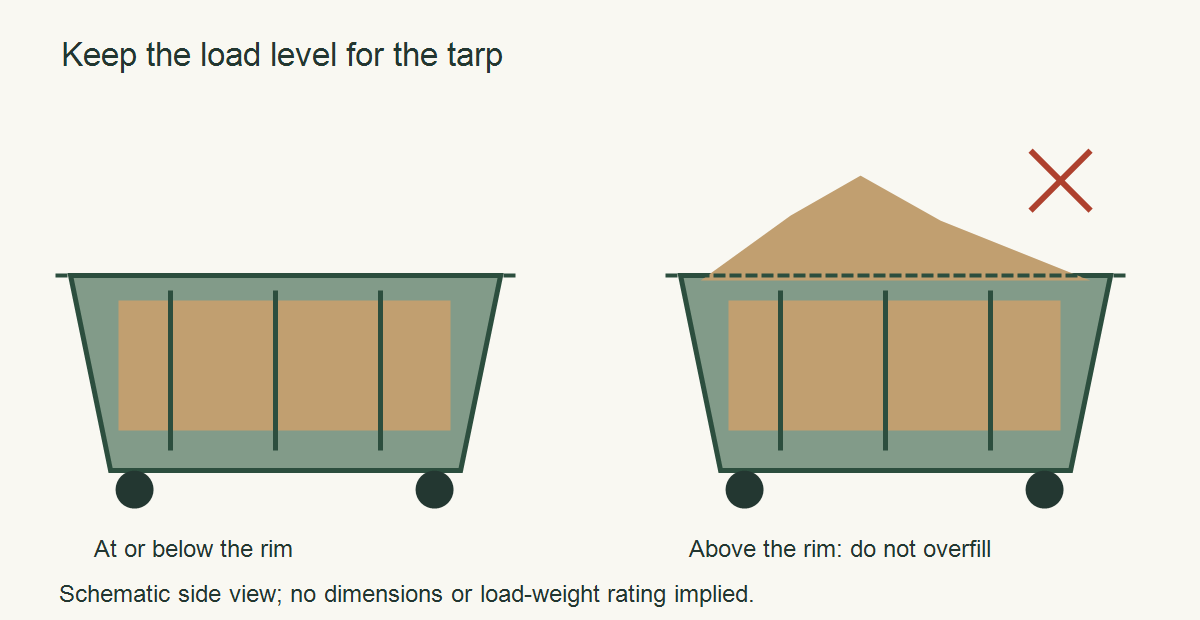
The linked forms require 24-hour call-in notice between 6 a.m. and 2 p.m. They also require a level load for the automatic tarp and say only Scottsboro Solid Waste trucks may move the roll-offs. Do not let a contractor reposition one with other heavy equipment. The 30-yard terms also warn that unauthorized material can prevent removal and trigger a $250 charge.
Work backward from the date the property must be clear. Agree with the contractor who will request the pull, who will remove anything rejected, and who carries any extra rental period. A notice requirement is not a promised pickup appointment. If a closing or photograph session depends on removal, obtain the service date rather than scheduling that event on the assumption that a last-day call will be enough.
Conclusion: Price a completed removal, not just a container
A useful Scottsboro project budget connects the waste description, size, months of use, pull and disposal charges, deposit treatment and retrieval plan. Keep the current quote and completed forms beside the contractor’s scope. That gives you a much clearer comparison than a single rental price—and a practical way to keep the home ready for its next stage.
Source review: October 28, 2026 UTC. Published city forms establish the terms discussed here; availability, current charges and placement must be resolved for the actual reservation. Featured image: AI-generated conceptual illustration, not a local property or the city’s equipment.
Want Personalized Real Estate Help?
If you are buying a home that needs work or preparing a Scottsboro property for sale, I can help you fit the project and moving timeline into your real-estate plans. Contact me to talk through your next step.
You can also browse Scottsboro-area homes while comparing your options. This is a general area search; it does not establish roll-off service, renovation permissions or a property’s suitability for equipment access.
Sharing is Caring:
Author