Jessica Hassan
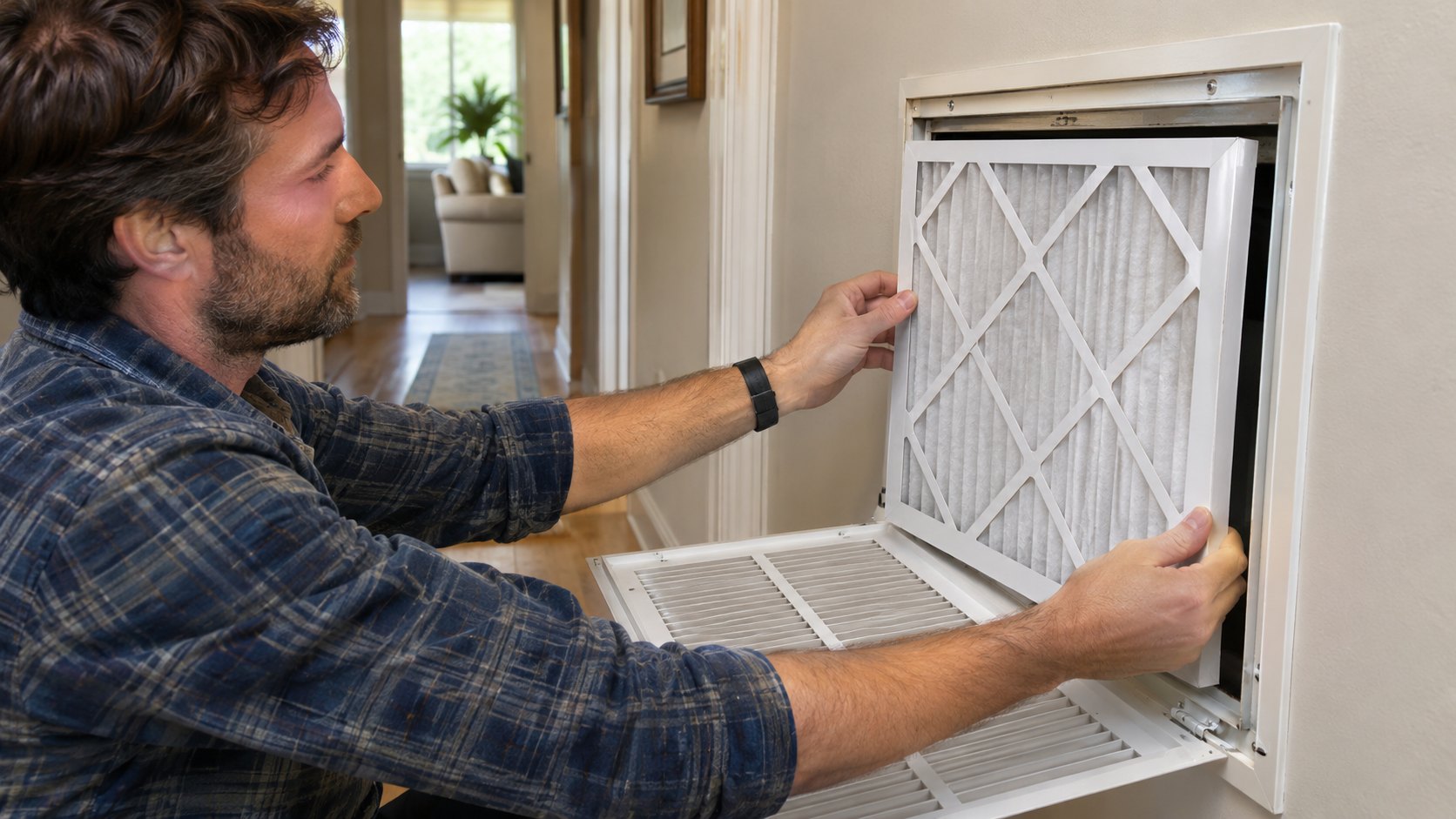
A filter is easy to buy and surprisingly easy to buy for the wrong place. In a newly purchased North Alabama home, the first decision is not a brand or a MERV number. It is finding where this particular heating and cooling system draws its air, what filter actually fits, and what the equipment can move air through. Those answers turn a recurring chore into a useful maintenance record.
This guide is for a household taking over an existing system, not a diagnosis of its condition. If a filter location is behind an electrical or unfamiliar service panel, ask the installer or a qualified HVAC technician to show you the owner-accessible maintenance point. The DOE-supported heat-pump owner handoff guide specifically calls for showing owners the filter location, whether it is reusable and how to change it.
Trace the return air before you shop
In a ducted system, room air returns through a grille and travels toward an air handler or furnace before conditioned air goes back to the rooms. A filter may sit at an accessible return grille or at the equipment; the visible grille alone does not prove it contains one. A ductless indoor unit has its own manufacturer-specified filter care. Do not assume the previous home’s filter location applies here, or that every visible grille should receive another filter.
Start with the thermostat and equipment information left at closing. Identify whether the home has a ducted air handler, ductless heads, or more than one system. With the system off and the owner’s instructions in hand, inspect only an accessible filter grille or owner-serviceable filter cover. Photograph the existing filter label, its location and how it sits before removing it. If there is no filter there, or the airflow path is uncertain, stop and ask for a technician walkthrough rather than improvising a second filter location. The heat-pump handoff guide distinguishes ducted filter locations from ductless filter care.
Fit comes before the rating on the package
Take the existing filter’s printed length, width and thickness to the owner’s manual or equipment schedule. Do not treat the grille’s outside dimensions as the filter size. A replacement should sit in its intended holder without crushing the frame or leaving an obvious gap around it. Air that slips around the edge avoids the media you paid for. The EPA Guide to Air Cleaners in the Home emphasizes a snug fit without bending or crushing the filter.
The arrow on a replacement filter indicates airflow direction; use the equipment or filter-holder instructions to orient it toward the fan, rather than copying a neighbor’s installation. If the old filter appears loose, damaged or oddly doubled, record what you found and ask a technician to confirm the intended arrangement. A larger or thicker filter cannot be made compatible simply by forcing it into a narrower slot.
Choose particle capture the system can support
MERV describes how well a filter captures tested particle sizes, not whether a particular fan and filter slot can use it. EPA’s MERV guidance says that if you upgrade, select MERV 13 or the highest rating the system fan and slot can accommodate, and consult an HVAC technician when necessary. That last condition matters: a high-efficiency label does not verify the airflow in an unknown house.
For example, a buyer may find a one-inch filter at a return grille and want the most efficient filter on the shelf. The useful question for the technician is whether that exact filter, at that size and thickness, suits the equipment and its airflow. The answer might be a compatible higher-efficiency filter, a different filter arrangement, or keeping the current specification until the system is evaluated. Do not promise that a rating change will cure a comfort problem, lower a bill or deliver a particular health result. EPA describes filtration as particle capture; system performance still depends on fit, airflow, operation and other indoor sources.
| What you find | Decision before buying |
|---|---|
| Readable filter and equipment instructions | Match all three dimensions and the specified type; confirm the orientation and replacement method. |
| Loose, bent or doubled filter | Document the opening and ask which single arrangement the equipment requires. |
| A proposed higher MERV rating | Check fan and filter-slot compatibility with the manufacturer or technician before upgrading. |
| Ductless indoor heads | Follow that model’s cleaning or replacement instructions; do not substitute a ducted-system filter. |
Make the next check easier than the first
Put a monthly inspection reminder on the calendar until you learn how quickly the installed filter loads under this household’s actual use. ENERGY STAR advises checking filters monthly and changing them when dirty; EPA says to follow the manufacturer’s maintenance and replacement instructions. That is more useful than assuming one universal change date. Record the date, size, type, MERV rating if applicable, location and any technician-confirmed limit. Keep one photo of the correctly installed filter for the next person who maintains the home.
For a ductless unit, use its model-specific cleaning directions. If the filter becomes dirty unusually fast, the grille never seems to fit properly, or airflow and comfort remain poor after routine care, schedule qualified service rather than stacking filters or repeatedly buying denser media. If the thermostat also shows unfamiliar AUX or Emergency Heat behavior, our North Alabama heat-pump controls guide addresses that separate operating question.
Final Thoughts
A good move-in filter decision has three pieces of evidence: the actual owner-accessible location, the dimensions and type that fit, and the system’s supported efficiency range. Save them with the home’s equipment records. If one piece is missing, a short technician walkthrough can prevent a guess from becoming a recurring maintenance mistake. The next filter purchase should then be a repeatable match, not another experiment.
Want Personalized Real Estate Help?
If you are buying, selling or relocating in Northern Alabama, I can help you turn equipment records and inspection questions into a clearer real-estate conversation. Contact me to talk through the property. A qualified HVAC professional should determine the equipment’s filter and airflow requirements.
Sharing is Caring:
Author

Sources and review notes
Sources checked November 19, 2026: EPA’s MERV guidance and Guide to Air Cleaners in the Home, ENERGY STAR heating-and-cooling guidance, and the DOE-supported heat-pump owner guide linked above. The featured image is an AI-generated generic filter-inspection scene, not an actual North Alabama property or an equipment-specific installation diagram.