Jessica Hassan
A shed catalog can tell you the advertised dimensions and delivery date. It cannot tell you where that structure may sit on a particular Madison lot. The City of Madison draws a building-permit line at more than 200 square feet for a pre-built or site-built shed, but its Building Department FAQ also sends owners to Planning for setbacks and possible historic or overlay review. Those are different questions. Settle the lot and placement before placing a nonrefundable order or scheduling a delivery truck.
This guide applies to property inside the City of Madison, which crosses Madison and Limestone counties. A Madison postal label is not enough to establish city jurisdiction. The city provides GIS and mapping resources; if the boundary is uncertain for the actual parcel, ask Engineering to confirm it before using the city-specific steps below.
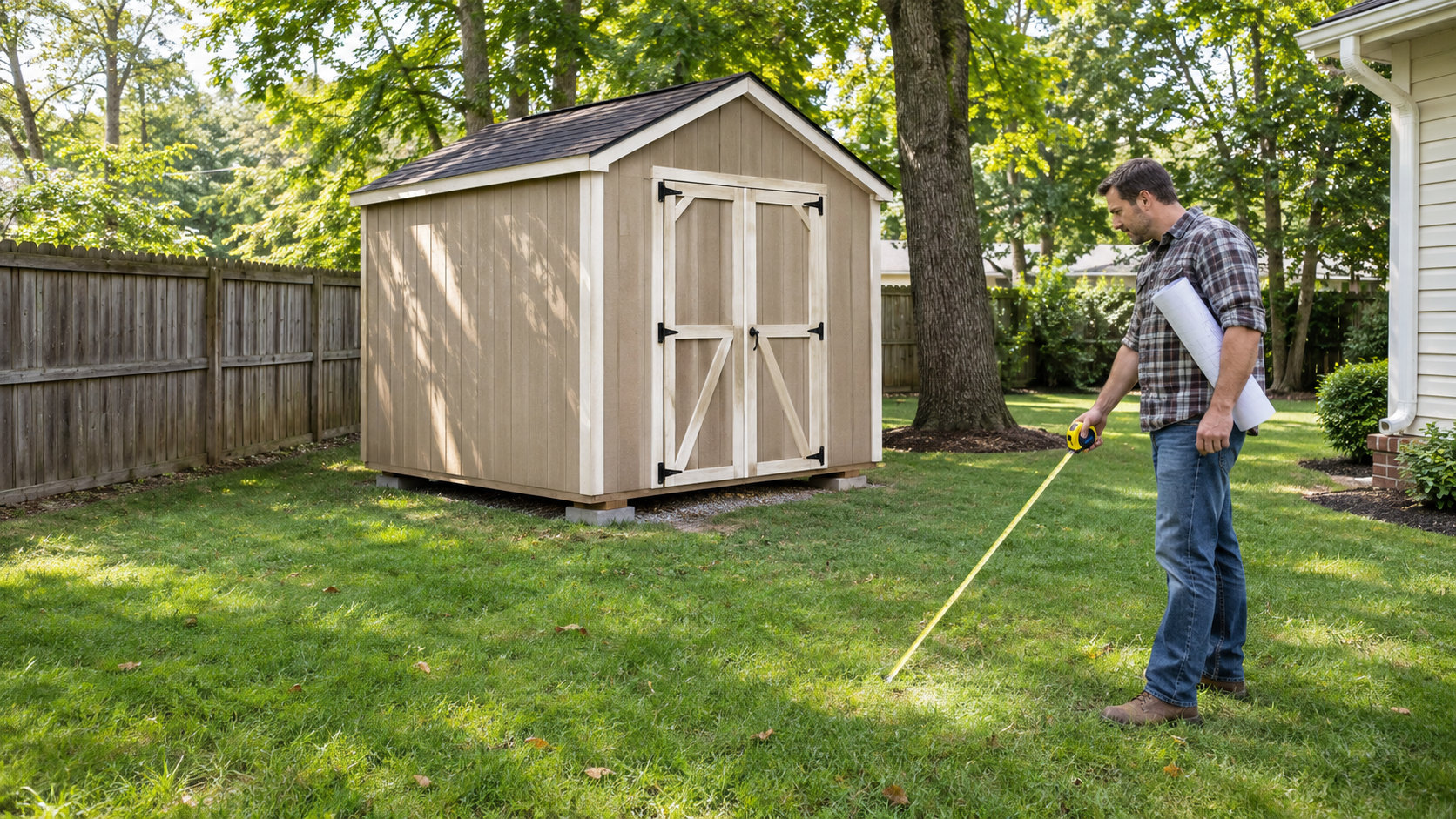
The featured image is an AI-generated generic backyard scene, not a Madison property or an approved shed placement.
Test two shed sizes against the same yard
Imagine two simple rectangular products for the same backyard. A 10-by-20-foot shed has a stated 200-square-foot footprint. Under the city FAQ, accessory buildings and sheds 200 square feet or smaller are among examples that do not need a building permit. A 12-by-20-foot shed is 240 square feet, so the FAQ says a building permit is required. Ask Building how it measures the proposed model if the catalog uses inside dimensions, includes an attached feature or leaves the square footage unclear; do not decide the threshold from a marketing label alone.
The smaller choice does not come with a free placement rule. For both options, the FAQ says to call the Planning Department at 256-772-5630 about setbacks and whether the property is in a historic or overlay district that may need Planning approval. The city’s permitting page also warns applicants to be aware of setbacks and easements before building. A 200-square-foot exception from a building permit does not resolve a lot line, drainage easement, design review or private covenant. Ask Planning where the proposed footprint may go before picking the model or paying for site work.
The city also recommends checking any homeowners’ association rules for shed type or style. That is a separate private restriction. The city’s permission, if required, does not waive an HOA covenant, and an HOA answer does not replace city review. If the property has no HOA, the city and lot questions still remain.
Give Planning a usable placement question
“Can I put a shed in my backyard?” is too broad. Instead, start with a rough sketch that marks the house, existing structures, property lines as best established, known easements and the proposed shed location. Add the model’s exterior dimensions and how it will be used. The sketch is a conversation aid, not a survey or an approved site plan. Ask Planning which setback and district rules govern this property, and what document it needs to evaluate the position. If the answer depends on a recorded plat or more precise boundary information, get the appropriate property record or professional measurement before treating the grass line as the legal line.
The location matters even for a delivered unit. A supplier may need room to carry or set the shed, but physical access is not permission to cross an easement or place the building inside a required setback. If the household may later add a fence, patio or utility line, describe that plan now so the city can distinguish the shed review from any separate work. The FAQ lists electrical work among permit-required projects; the shed’s size exemption is not an exemption for new electrical service.
Make the permit and installer route explicit
For the 240-square-foot example, the city’s permitting page lists new storage buildings over 200 square feet as permit-required and says building or trade permit applications need a signed application plus a customer-signed invoice or contract stating scope and price. Before a delivery or construction date is fixed, ask Building at 256-772-5644 which application, drawings, contractor information, inspection steps and fees apply to the actual design. The same page links the residential building application and the permit portal. The portal says registered users can submit applications and explains its parcel-number step, but a web account or form submission is not an issued permit.
Who is doing the work also changes the preparation. The FAQ says contractors must hold a valid state license and a current City of Madison business license to build or place any size pre-built shed or storage building in city limits. That clause matters for the 200-square-foot example too. Ask the vendor who will deliver and place it, how the licensing is documented, and who will submit any required city paperwork. If you plan to do the work yourself, ask Building which owner-performed work rules apply rather than assuming the vendor rules vanish or automatically apply to you.
A useful written order sheet therefore has two parts: the product’s actual exterior size and intended use; and the property-specific placement, installer and utility plan that Planning and Building can evaluate. If the city requires changes, revise that sheet before the vendor fabricates or delivers the shed. This prevents the common sequence of paying for a unit and only later discovering that the desired corner is not available.
If the shed is already there, ask a different question
A buyer looking at a home with a shed is not ordering a new one. Ask the seller what was built or delivered, when, by whom and what city or HOA records they have. Our Madison public permit-record guide explains how to start a city record search by service address and why a missing online row is not proof that work was exempt or approved. A past record also cannot approve a new location or electrical addition. Use it to formulate a precise question for Building, not as a substitute for inspection or current Planning advice.
Conclusion: choose the lot position before the catalog model
Within Madison city limits, the city’s 200-square-foot threshold answers one building-permit question. Placement, historic or overlay status, easements, HOA restrictions, installer licensing and any electrical work remain separate. Compare actual exterior dimensions, take a proposed position to Planning, and ask Building about the permit and installer route before committing to the order. A compact shed can be a good fit for a yard, but its size alone cannot establish that fit.
Want Personalized Real Estate Help?
If a Madison-area home appeals because of its yard or an existing outbuilding, I can help you keep the property questions organized while Planning, Building and qualified professionals answer the site-specific ones. Contact me to discuss a home you are considering.
You can also browse homes around Madison as a starting list. The search reaches nearby communities as well as Madison and does not establish city limits, setbacks or whether a shed can be installed on any particular lot.
Sharing is Caring:
Author