Jessica Hassan
Applying for Alabama weatherization help is the start of a process, not a date for new insulation or a promise that a particular repair will be done. A household can pass the income screen and still wait for funding, an assessment of the home and permission to do the work. Knowing those stages helps an owner or renter prepare for the right conversation without planning a move or a repair around an unconfirmed project.
This guide follows the Alabama Weatherization Assistance Program from county intake through final inspection. It deals with the home’s longer-term energy use. If the immediate problem is paying a current utility bill, our North Alabama 2-1-1 guide explains how to find a referral and why the service provider, not the directory, decides an application.
The county agency takes the application
ADECA administers the program but does not take household applications. Its weatherization regions directory assigns the 13 Northern Alabama counties in this site’s coverage area to four local agencies. Use the county of the home to be assessed, even if you are now living elsewhere:
- Colbert, Franklin and Lauderdale: Community Action Agency of Northwest Alabama says to call 256-383-3832, extension 124 for weatherization information.
- Limestone and Madison: Community Action Partnership of Huntsville/Madison and Limestone Counties; ADECA lists 256-851-9800 for the agency.
- Cherokee, DeKalb, Jackson and Marshall: Community Action Agency of Northeast Alabama directs applicants to schedule a county-office appointment at 256-999-1166.
- Cullman, Lawrence, Morgan and Winston: Community Action Partnership of North Alabama offers mail, email and online application paths; its weatherization page lists 256-260-3116 for questions. For its online path, the agency says the email-confirmation step is required or the application is not submitted.
These are program-specific routes, not proof that a local office has an appointment or funds available today. The agencies describe different intake steps. Start on your serving agency’s linked page, then use its current instructions for documents and submission; do not send identity or income records to a general contact found elsewhere.
Income screening and the waitlist answer different questions
ADECA’s 2026 state plan describes a gross annual household-income test using the 12 months before application. Its ordinary income route is at or below 200% of the federal poverty level, and it also describes qualifying benefit-based routes. The local agency verifies the household and the dwelling; a reader’s quick calculation is not an eligibility decision. An agency may ask for household income records, proof of ownership or tenancy, and utility information. Its exact current document list matters more than an old generic checklist.
After screening comes a separate queue. The state plan gives priority to categories such as an older or disabled household member, children, high energy use and high energy burden. Northeast Alabama’s agency says applications are ranked by priority points and that limited funded homes make a wait estimate difficult. Imagine two households that both pass the income test: the one with greater qualifying priority may be selected first. Neither household can turn an eligibility result into a reliable installation date. Ask the agency how it records your application, what stage it is in and how it will contact you if the home is selected.
The assessment chooses the work, not the applicant’s wish list
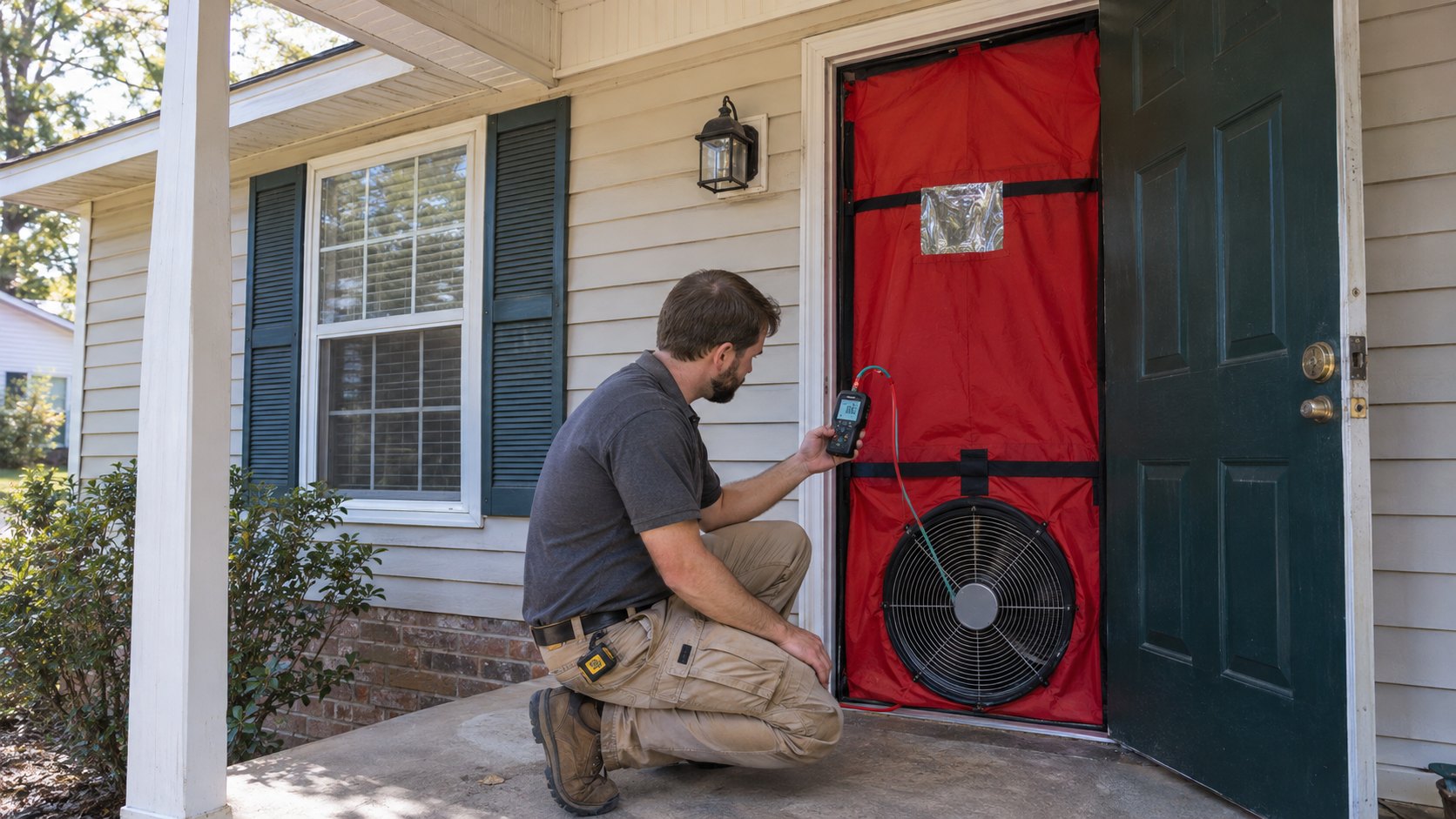
When a home is selected, the Department of Energy’s application guide says a trained auditor reviews energy bills, uses a blower-door test to measure unwanted outside-air leakage and inspects the home’s energy equipment and spaces for efficiency and health or safety issues. The temporary fan panel in the article’s generic featured image illustrates that test; it is not a visit to a North Alabama home.
The audit turns those observations into a scope of cost-effective measures. The DOE whole-house explanation considers the building shell, heating and cooling, other energy use and safety together. Depending on the dwelling and program determination, the work might involve air sealing, insulation, ducts or equipment; seeing a drafty window does not entitle an applicant to a replacement window. This is why an energy assessment differs from a shopping list of home upgrades. The agency or crew should explain the selected scope and schedule before work begins.
A needed repair can pause weatherization
Income eligibility does not mean every house is ready for efficiency work. Alabama’s 2026 plan says a structural or health-and-safety issue can lead to a deferral. For example, an unresolved roof leak may need attention before attic insulation would make sense. The plan describes separate Weatherization Readiness Funding that can sometimes address such barriers, but the agency must assess the dwelling and available route; it is not an applicant-controlled repair allowance or a promise to replace a roof.
If the agency defers the home, ask for the specific condition, whether its readiness process applies and what documentation would let the agency reassess it. The state plan says agencies look for another local assistance route for a deferred home and may refer a household to USDA or 2-1-1. For a qualifying owner-occupied rural home in the Shoals, our USDA Section 504 repair guide explains a separate loan or grant inquiry. It is not a weatherization approval or a repair route for every county.
Renters can apply; permission and inspection still matter
The DOE guide says both owners and renters may apply. For a rented home, Alabama’s 2026 plan calls for a signed rental release from the tenant and owner before work. The plan says that agreement prohibits a rent increase for one year based solely on the increased value due to weatherization; it does not freeze rent for all reasons. A renter can begin by contacting the county agency and asking what it needs from the landlord, without treating a landlord’s informal verbal agreement as the required release.
After approved work, DOE says a local program inspector checks completion, the applicable work specifications and safe operation of equipment. That final visit is part of the service, not a homeowner’s self-certification. Keep the agency’s scope, contact information and inspection record with the home’s maintenance papers. For a sale or lease transition, those records explain what was done; they do not guarantee a future energy bill or a new household’s eligibility.
Conclusion: plan around the stage you have reached
Find the county’s weatherization agency, submit its current application and treat the income decision as one milestone. Priority ranking, a home assessment, owner permission where needed, the selected work and final inspection are different milestones. If a house is deferred, ask what specific barrier must change before work can proceed. That sequence gives you an accurate plan without counting on an unpromised installation date or a particular upgrade.
Want Personalized Real Estate Help?
If you are buying, selling or relocating in Northern Alabama, I can help you put the home’s condition, records and your moving timeline into the real-estate conversation. Contact me to talk through the property questions. The county agency decides weatherization eligibility, work and timing.
Sharing is Caring:
Author
Sources and review notes
Sources checked November 18, 2026: ADECA’s weatherization page and 2026 state plan, DOE’s application and whole-house guides, and the four local agency pages linked above. Agency intake, contact details, funding and wait times can change. Featured image: AI-generated generic blower-door assessment scene, not an actual applicant or North Alabama property.