Jessica Hassan
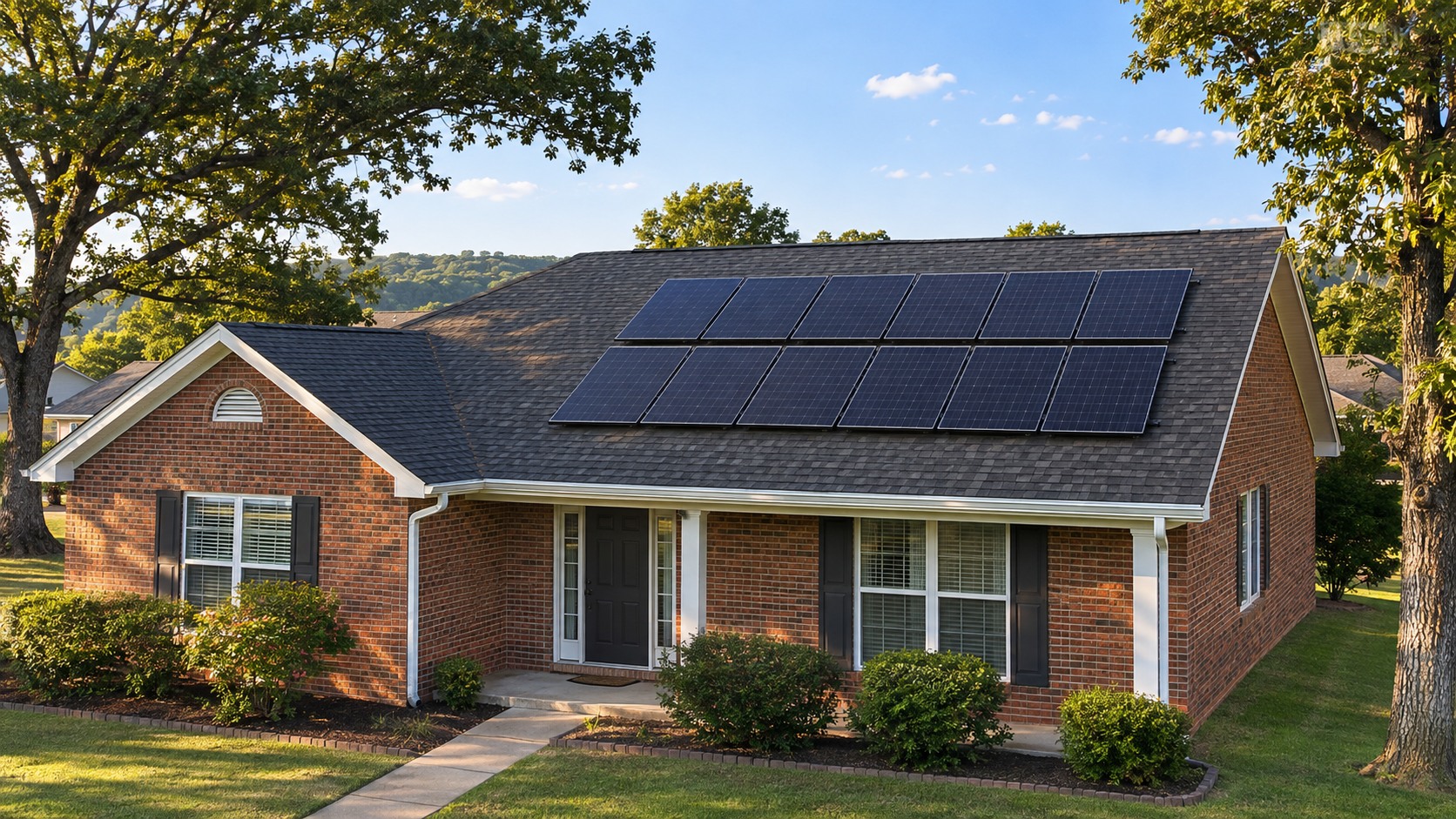
Two solar proposals can predict the same amount of electricity and still have different effects on a Huntsville Utilities bill. The missing detail is where that energy goes: some may supply the house as it is produced, while the rest goes out to the grid. For a Madison County homeowner comparing quotes, that split is more informative than a single annual-production number.
Huntsville Utilities’ Solar Connect program purchases excess generation from participating customer-owned, behind-the-meter systems. Its published 2026 export purchase rate is $0.064270 per kilowatt-hour. HU says it does not offer net metering or net billing. An exported kilowatt-hour therefore should not be treated as a credit for a kilowatt-hour bought later at the household’s retail rate.
Self-use and exports belong on separate lines
Self-use means solar electricity supplies the home rather than going through the meter to the grid. Its bill effect is the grid electricity the home does not need to buy at that time. Exported energy is different: it earns the applicable Solar Connect purchase credit. A proposal that multiplies all solar production by one price hides this distinction.
Here is an invented comparison, not a production forecast. Both cases assume a system produces 1,000 kWh during an illustrative period, with no battery and no storage accounting. The only difference is how much of that production the household uses directly.
| Illustrative allocation | Case A | Case B |
|---|---|---|
| Solar production | 1,000 kWh | 1,000 kWh |
| Used directly at home | 400 kWh | 700 kWh |
| Exported to the grid | 600 kWh | 300 kWh |
| Export credit at the posted 2026 rate | 600 × $0.064270 = $38.56 | 300 × $0.064270 = $19.28 |
Credits are rounded to cents. Case B has a smaller export credit, but that does not mean solar helped less: it also displaced 300 more kWh of purchases from the grid. To compare the bill effects, value those 300 kWh at the applicable avoided usage charges and compare that amount with the $19.28 of export credit given up. No retail rate is assumed here, so this example does not calculate total savings.
That is why the proposal should show estimated production, self-use and exports separately, along with the household-use assumptions behind them. The example does not tell you to increase consumption just to use solar electricity. It shows why a large export-credit estimate alone is not a measure of a better design.
Fixed account charges and payment arrangements also need their own treatment. My guide to Huntsville Utilities bills and budget payments explains the difference between electricity use, the bill and payment timing. A smoother monthly payment is not evidence that solar produced more energy or reduced consumption.
The program limits are not a system recommendation
Solar Connect lists a $100 application fee billed to the account, a 50-kW maximum, and a participation cap. The local inspection authority determines the permitted installation size from the equipment. A program ceiling is not a recommendation to install that much capacity, nor a promise that a particular project can enroll.
The interconnection agreement uses a threshold of more than 10 kW AC for the additional insurance requirement; HU’s FAQ specifies at least $1 million in general liability coverage above the threshold. Have the proposal identify its AC rating clearly so the insurance discussion concerns the same equipment rating as the agreement, not an unexplained headline number.
These terms apply to HU customers. Its electric-service page describes service across Madison County and a small part of Marshall County. For an individual house, use the provider shown on the electric account. A Madison-area listing or mailing address is not proof that these program terms govern its meter.
From a proposal to permission to operate
The Solar Connect application ties the project to an account, meter and service address. It collects the installer, electrical contractor, equipment and system ratings, and calls for a one-line diagram and manufacturer specifications. The form explicitly distinguishes applying from permission to connect. A proposal should assign responsibility for preparing that package rather than leaving it as an unpriced task for the homeowner.
HU’s program instructions also call for a site plan and placards and specify NABCEP requirements for design and installation. Following design review and installation, the agreement’s closeout sequence includes the local authority’s inspection/certification, a witnessed commissioning test and HU’s signed Permission to Operate before parallel operation. Panels on the roof are not the final milestone.
The public application requires equipment to disconnect from the grid during an outage. For that reason, do not read “solar installed” as proof of usable backup power. HU says batteries may be allowed with additional requirements; any backup function needs to be part of the actual reviewed equipment and design, not an assumption attached to the panel count.
Compare the complete cost, and keep the records with the house
The $100 fee is not an all-inclusive interconnection price. The agreement assigns applicable meter/distribution modifications and incremental transformer-upgrade costs to the customer, and requires payment of the good-faith upfront estimate at signing. Keep the installer’s quote and HU’s written interconnection estimate together when comparing total project costs.
A buyer considering an existing solar-equipped home needs a different packet from someone commissioning a new installation: the equipment information, inspection records, signed Permission to Operate and current agreement. The agreement requires 30 days’ advance written notice and HU’s written consent for assignment. Build that transfer conversation into the transaction timeline rather than treating a seller’s export credits as automatically transferable.
For a new project, the useful pre-contract result is one consistent set of numbers and responsibilities: production divided between self-use and exports, the approved equipment rating, the utility cost estimate, applicable insurance, and the steps through operating permission. If the linked technical requirements are unavailable, obtain the current version from HU’s DER team at DER-Services@hsvutil.org before treating the design as complete.
Final Thoughts
A solar quote becomes easier to judge when it explains both the energy and the installation. Separate electricity used at home from electricity sold to HU, then compare the full project cost and approval timeline. The 2026 export rate answers one part of that calculation; it does not establish a household’s payback, a future-year rate or the suitability of a particular roof.
Want Personalized Real Estate Help?
Solar equipment can add another layer to a home purchase, especially when records and utility arrangements need to follow the property. I can help bring those questions into your home search and transaction planning. Contact me about your move, or browse homes near Madison, AL to explore the area. That regional search does not establish a property’s utility provider or solar eligibility.
Program, application and agreement reviewed November 6, 2026. The purchase rate shown is for 2026; terms and participation availability may change. No individual system’s production, savings or approval was assessed.
Sharing is Caring:
Author