Jessica Hassan
A lifted concrete panel and a block with no sidewalk may interrupt the same walk, but Huntsville treats them as different city work. One is a request to repair an existing public sidewalk. The other asks the city to consider a new sidewalk project and possible capital funding. Before sending either request, identify the exact gap or hazard and the street authority; the mailing address alone does not settle who maintains the pavement.
Start with what is on the ground
| What you can observe | City route to investigate | What the request can establish |
|---|---|---|
| An existing sidewalk panel is displaced or otherwise unsafe | Report the specific location through Huntsville Connect | Public Works can review a maintenance problem on a city sidewalk; the report is not a promised repair date. |
| There is no sidewalk on the desired connection | Read the Sidewalks planning page and its linked Sidewalk Project Application | Planning can consider a proposed addition under its criteria; an application is not a funded or scheduled project. |
| The location or road owner is uncertain | Use the city’s GIS and address-service tools, then ask the city to confirm jurisdiction for the exact segment | A city boundary or address check can direct the question; it does not by itself determine every right-of-way duty. |
The distinction matters for a home search. A route from a house to a bus stop, park or nearby errand can contain both a damaged panel and a missing link. Reporting the panel does not make the missing link part of a repair ticket, while proposing a new link does not fix an immediate trip hazard. Make two precise records if the walk has two different problems.
For a damaged city sidewalk, make the repair location unmistakable
Huntsville says its Public Works Department maintains sidewalks within the City and repairs portions that become displaced or otherwise unsafe. The city’s published route for reporting an unsafe sidewalk is Huntsville Connect, a non-emergency service channel. Its instructions ask the reporter to choose a category, place a map marker or enter an address, attach a photo if possible, describe the issue and submit. The portal can track a report, but a submitted ticket does not tell you when a crew will inspect or repair it.
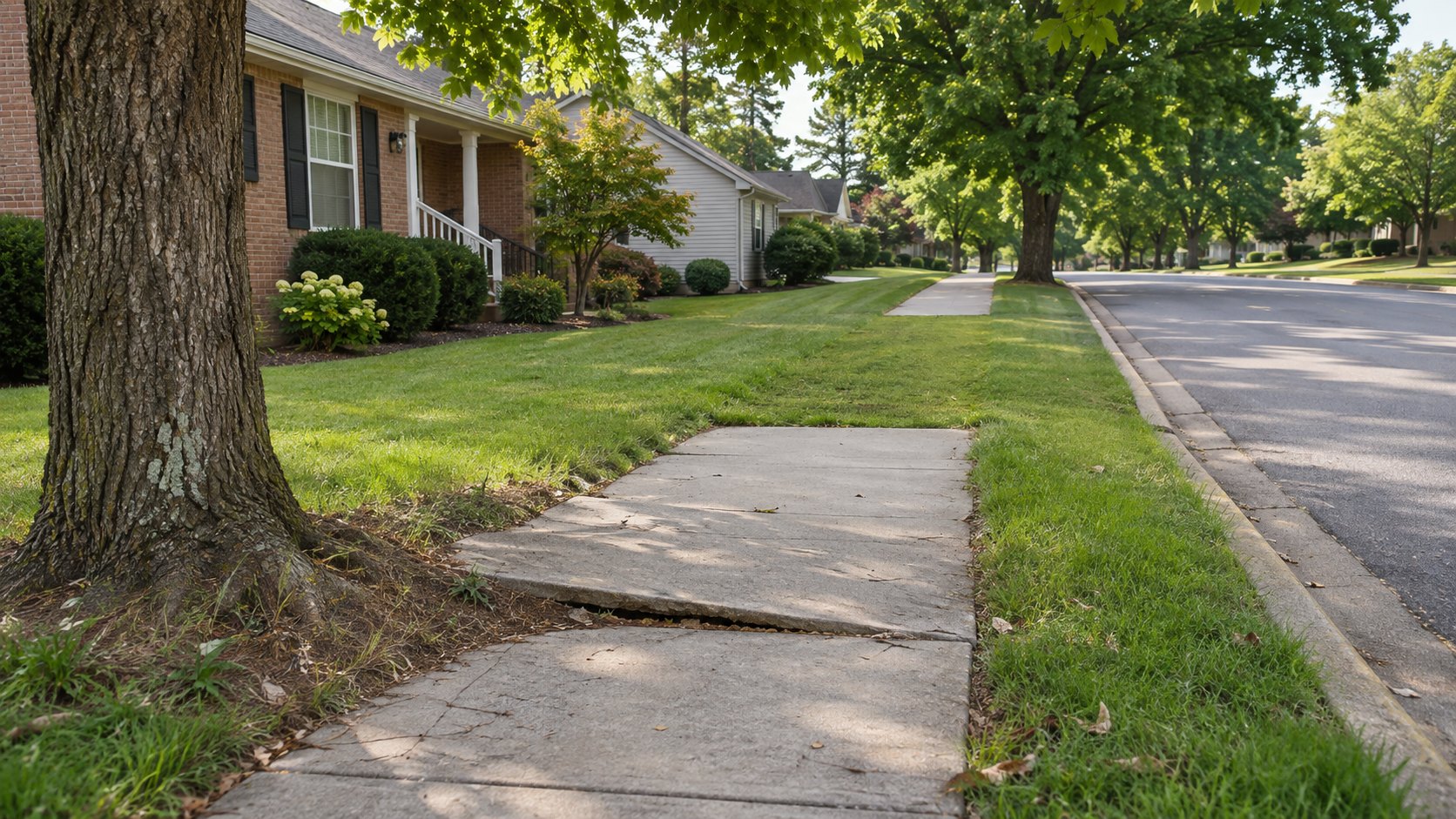
For example, “the north-side sidewalk between two named cross streets has a raised panel beside the large tree” gives a reviewer a usable location. Add a clear photograph and the closest address or landmark when available; avoid entering a neighbor’s private details into a public request. If someone is in immediate danger, use the city’s emergency instruction rather than treating Connect as an emergency response. The pictured sidewalk in this article is an AI-generated generic example, not a city inspection or a report about a real address.
For a missing link, describe the trip it would complete
A blank grass strip is a different kind of question: should the city build a new connection there? Huntsville’s current Sidewalks page directs citizens to its Sidewalk Project Application. It says proposals are considered if criteria are met, and a chosen project is added to the capital plan for the next budget year. That is a planning step, not a construction promise or a statement that the city owns the proposed strip.
Make the proposed limits concrete: “from the existing walk at this intersection to the next existing walk,” plus the side of the street and the pedestrian destination that the gap separates. A useful request explains who must now leave a continuous route and where the gap begins and ends. The city’s 2022 explanation of sidewalk prioritization identifies safety, equity, connectivity and feasibility, and notes that grade, drainage, utilities, design and right-of-way can affect a new project. That background explains why a short-looking gap may still need engineering and funding; its old timeline is not a current estimate for any address.
The live application page visibly requests a Sidewalk Petition attachment. It does not explain in the text available here who prepares that petition or what support threshold applies. Before collecting signatures or presenting the application as complete, ask the Planning Office how to obtain the current petition, whose signatures count, and whether your proposed segment qualifies. The page lists 256-427-5100 for Planning questions. Do not borrow the petition rule from the city’s separate traffic-calming program.
Test the walk, then verify the city boundary
Walk or examine the actual route at a time relevant to your household, noting where the sidewalk changes side, ends, narrows, crosses a driveway or becomes unusable. The city’s FAQ says older Huntsville neighborhoods often have missing sidewalks, while some existing walks are narrow or obstructed by poles and roots. Those are reasons to look closely, not proof that a specific block is scheduled for work. A listing photograph, navigation map or “Huntsville” mailing label cannot replace a site-specific check.
Huntsville’s GIS hub includes city-limits and address-service tools. Use the exact location to begin a jurisdiction check, especially near municipal edges, and contact the city if the map or maintenance owner remains uncertain. A sidewalk along a state route, a private path or a neighborhood outside municipal limits may need a different decision-maker; this article cannot assign ownership from an address alone. Keep a record of the city response and the condition you observed on the date of a visit.
What each response means for a move
A Connect report means the city has a location to review; a project application means Planning has a proposal to consider. Neither establishes a repair date, capital appropriation, design, construction start or continuous future walking route. If a buyer needs a usable walk now, judge the route that exists today. If a proposed link would improve a future routine, treat it as an upside contingent on city decisions, and ask for the current project status rather than relying on a past fiscal-year image or a neighbor’s expectation.
Conclusion: keep present conditions and proposals separate
A speeding concern is a different city process, with measurements and neighborhood support rules of its own. My Huntsville traffic-calming guide explains that decision separately. Here, the useful next step is simpler: identify the broken or absent segment, choose the matching city route, and preserve the answer for your property decision.
Want Personalized Real Estate Help?
If a walkable route matters to your Huntsville home search or sale, I can help you compare what is physically there with a proposed city improvement. Contact me to talk through the property decision; the city determines sidewalk maintenance and project selection. You can also explore Huntsville-area homes, then verify each candidate walk and jurisdiction individually.
Sharing is Caring:
Author