Jessica Hassan
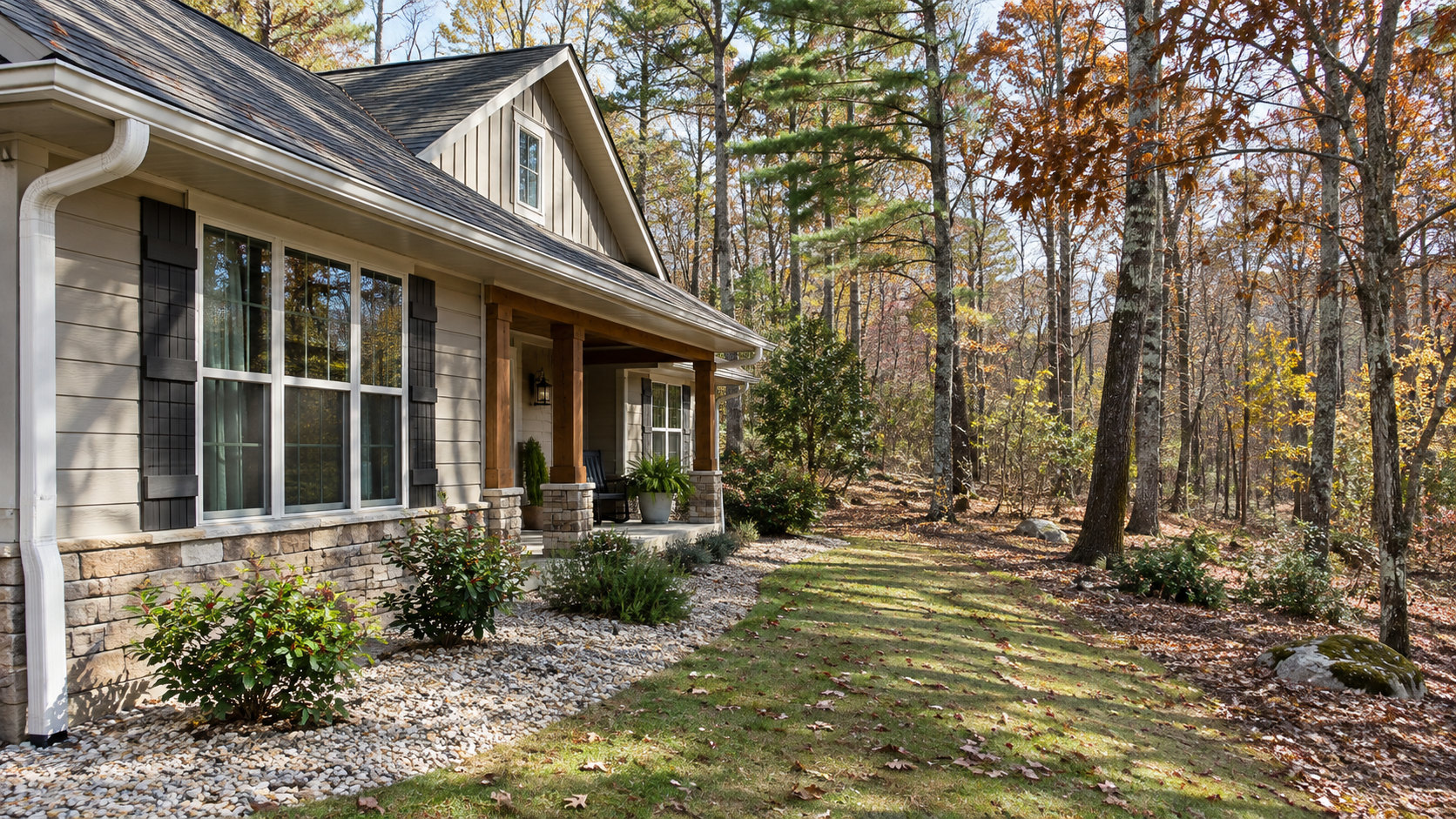
The view from a wooded North Alabama home can be the reason you love it. If you are buying one—or taking a fresh look at the one you own—do not make the first question simply how many trees surround it. Look at how an ember or small surface fire could reach the house, and at which changes would preserve the setting while breaking that path.
Featured image disclosure: This AI-generated photograph is a generic wooded-home scene. It does not depict an actual North Alabama property or establish the wildfire exposure or safety of any home.
This is a walk-through for comparing visible features and planning a property-specific assessment, not a wildfire score for any address. The Alabama Forestry Commission (AFC) treats homes at the forest edge as a long-term management question and offers homeowner resources for the wildland–urban interface.
The roof edge may matter before the distant woodline
A wooded lot has more than one path for fire. The U.S. Fire Administration’s explanation of wildfire exposure describes windborne embers, radiant heat and direct flame. Embers can land on a roof, enter through an opening, or ignite nearby landscape materials and attached features. Those routes explain why the condition of the house and the vegetation close to it deserve separate attention.
From a safe ground-level view, look for leaves or pine needles in roof valleys and gutters, damaged roofing, visible openings around vents, and a deck or porch with combustible storage beneath it. The U.S. Fire Administration’s home ignition zone guidance calls for clearing roof and gutter debris, repairing loose or missing roofing and moving burnable material away from exterior walls. Its ember guidance also identifies vents as potential entry points. A clean-looking forest beyond the yard would not offset dry needles against a roof opening. Arrange qualified help for roof, vent or high-gutter work rather than climbing or altering an unfamiliar assembly yourself.
Inspect the first five feet as a connection to the house
The U.S. Fire Administration identifies the house and the area from zero to five feet from its exterior as the immediate zone. Its guidance calls for moving firewood piles, leaves, flammable mulch and other burnable material away from exterior walls. It also includes attached decks and fencing in the near-house area. Look around corners, steps and fence connections, not only the front facade. This first zone does not mean every plant on a wooded lot must go.
Imagine two otherwise similar wooded homes. At one, a woodpile sits beside siding and fallen leaves collect under a porch. At the other, those materials are separated from the building and the near-house edge is maintained. That comparison does not certify the second home as safe. It shows how a manageable material choice changes an ember’s potential landing place and a surface fire’s route to the structure. An attached wood fence can be another path to inspect; the U.S. Fire Administration includes attached fencing in the first zone. Ask a qualified professional how to address a particular connection.
Keep the landscape, but interrupt a continuous fuel path
Beyond the near-house edge, the aim is an arranged landscape rather than a cleared moonscape. The U.S. Fire Administration describes an intermediate area from five to 30 feet, where maintaining vegetation and removing growth beneath trees can interrupt a fuel path. In its outer area from 30 to 100 feet, it calls for cleaning ground litter and dead plants, including near outbuildings. These distances are planning guidance, not an address-specific rule or permission to work beyond your property line.
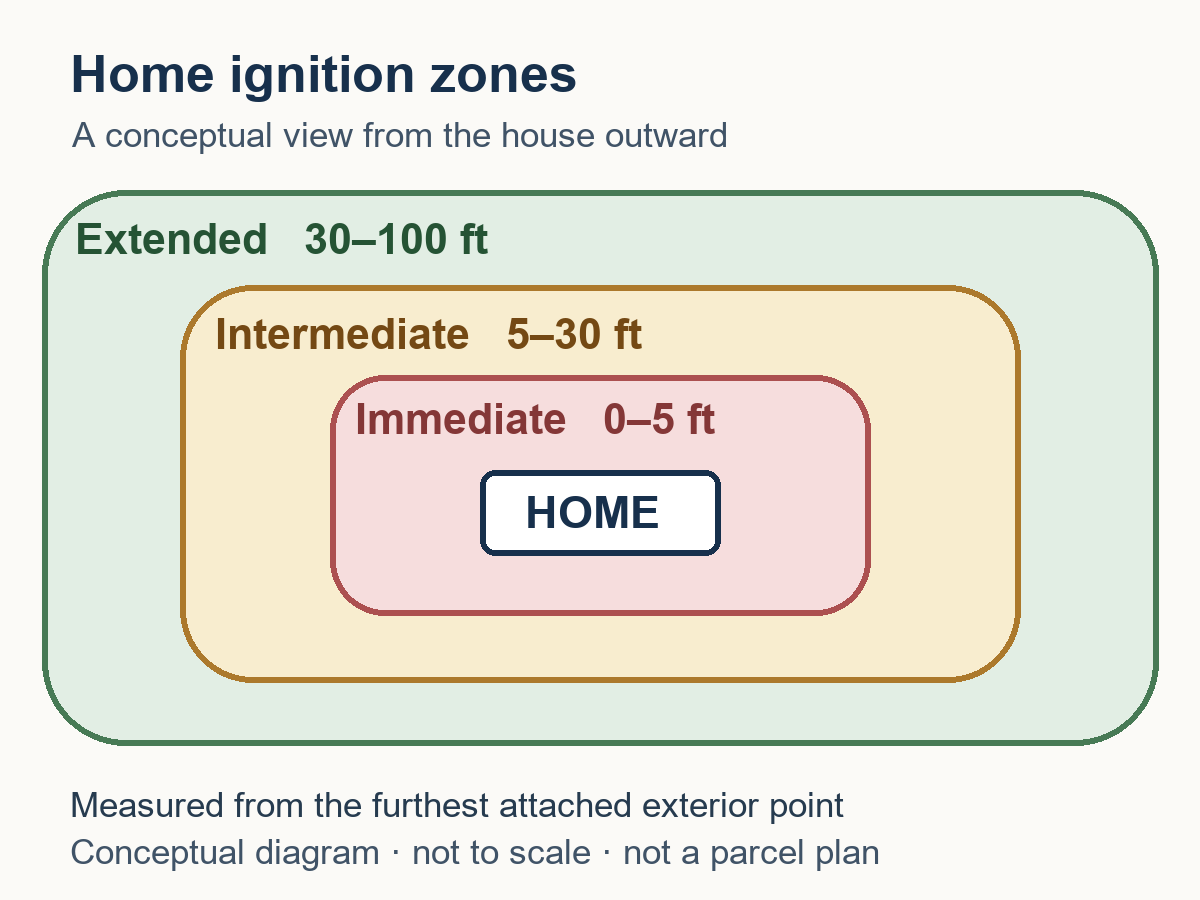
The U.S. Fire Administration’s guidance calls for maintaining healthy vegetation while removing dead material and ‘ladder fuels’—growth under trees that can carry fire upward. It does not require treating every tree as a problem. Ground litter, shrubs and low branches can connect a surface fire to a larger plant or a structure; a canopy photograph by itself misses what is happening underneath. On a sloping lot, vegetation arrangement and the house’s position require more careful assessment; avoid applying a flat-lot sketch as if it measured your parcel.
For a practical first pass, stand where you can see each side of the home and trace a possible continuous path: leaf litter to low shrubs, shrubs under trees, then material beside a deck, fence or wall. Note the specific links you observe. A landscaper or forester can decide which pruning, plant spacing and maintenance steps fit the species, slope, boundaries and any applicable restrictions. If a branch is near a utility line, leave line clearance to the utility or its qualified crew. For the distinct public-tree and electric-line questions inside Huntsville, see our Huntsville tree-work guide; its city rules do not govern other communities.
Turn a showing or maintenance visit into a short evidence list
- House: Photograph visible roof/gutter debris, vents, siding, decks and attached fences from a safe position. Separate routine cleanup from construction work that needs a qualified contractor.
- Near-house materials: Record mulch, leaves, firewood, furniture and storage touching or close to the structure; identify what can be relocated without claiming the whole site is protected.
- Landscape: Note continuous ground vegetation, dead material, outbuildings, slope and where a proposed treatment would cross a neighbor’s land or a utility space.
- Access and records: Ask the local fire organization about access and water-supply questions, and request existing tree/landscape work records or professional assessments. A visible driveway or hydrant does not establish response capability for this property.
These notes help a buyer price and sequence further evaluation; they are not a substitute for an inspection, contractor estimate, insurer’s own underwriting or a local fire assessment. The AFC’s homeowner FAQ specifically recommends contacting the local AFC office for a property risk assessment when a house is surrounded by woods. Ask the local office or fire department which assessment service and current guidance apply to the exact address.
Conclusion: start where fire could meet the building
A wooded setting is not a yes-or-no verdict. Start with roof and opening condition, then the first few feet of materials, then the continuity of vegetation farther out. That order follows the ignition routes and produces a useful list of maintenance, contractor and property-specific questions. It also lets you keep valued trees where a qualified assessment supports them, rather than assuming every tree is the problem.
Want Personalized Real Estate Help?
If you are comparing a wooded home with your other Northern Alabama options, I can help you keep the property’s visible maintenance needs and professional follow-up questions organized alongside the rest of your buying or selling plan. Contact me to talk through that next step.
Sharing is Caring:
Author

Sources and review notes
Sources checked November 21, 2026: AFC wildland–urban interface resources and homeowner FAQ, and U.S. Fire Administration guidance on wildfire embers, home ignition zones and landscape maintenance linked above. The featured image is an AI-generated generic wooded-home scene, not an actual North Alabama property or a wildfire-safety assessment. The inline zone diagram is an original not-to-scale concept using the U.S. Fire Administration’s distance bands.