Jessica Hassan
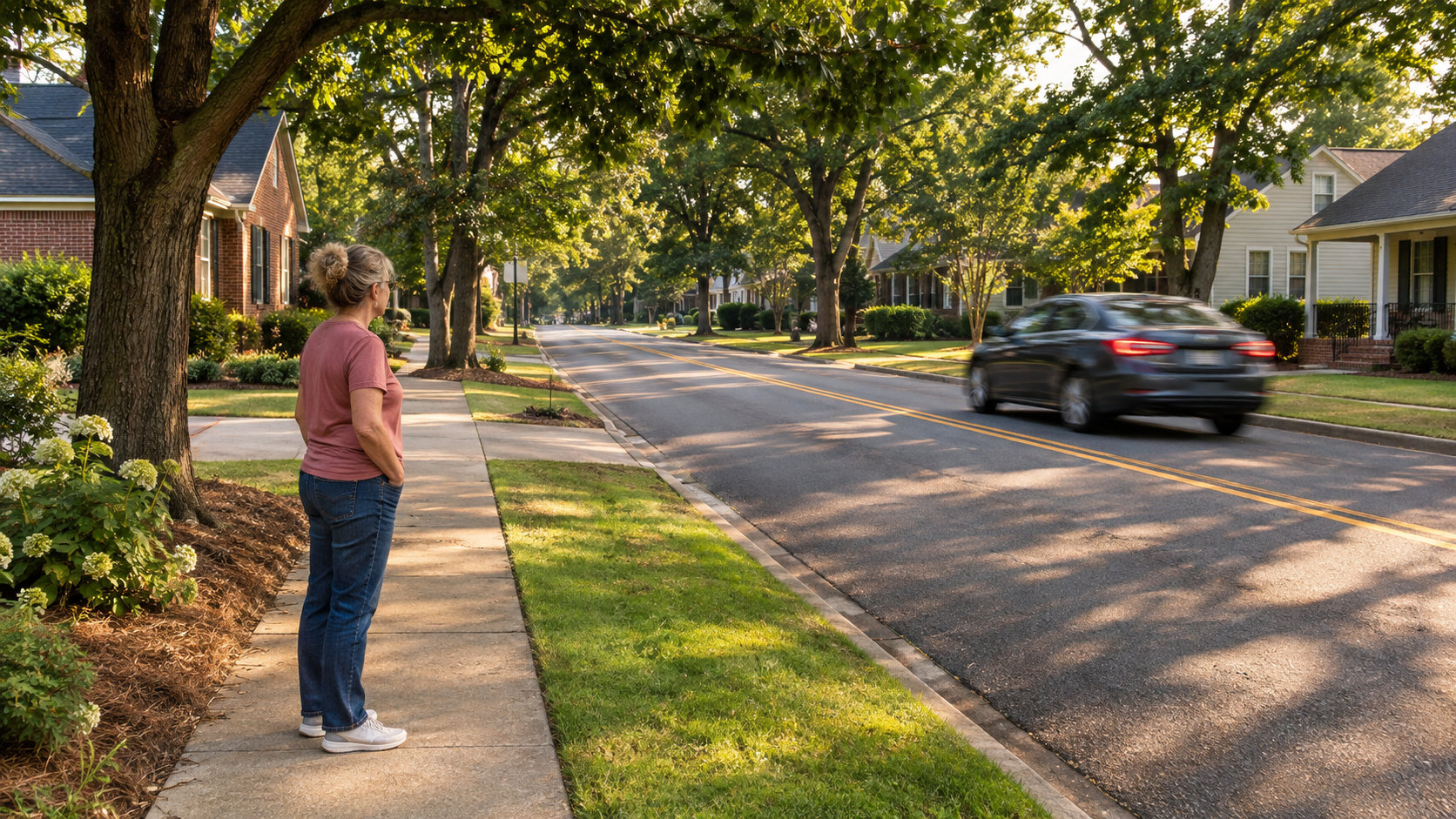
A car cutting through your Huntsville neighborhood may make a speed cushion sound like the obvious fix. The city’s Neighborhood Traffic Calming Program offers a way to request a review, but its decision is built from more than one resident’s observation. The street itself must qualify, the city measures traffic, neighbors are polled, and projects compete for annual funding. That sequence helps you decide what to submit now—and what you should not promise a buyer or neighbor.
This is a City of Huntsville residential-street program. A Huntsville mailing address does not prove that the street is inside city limits or under this program. The city’s GIS hub links city-limit and address-service tools; if the boundary or road authority is unclear, give Traffic Engineering the exact street and cross streets before assuming this is the right request route.
First, see whether the street fits the city’s stated screen
The current program page describes local residential streets affected by speeding or drivers using the block as a shortcut. Its currently linked traffic-calming flow chart says a roadway must have no more than two lanes and a posted 25 mph limit to be eligible for speed cushions. It also shows an early Fire and Rescue check for a critical emergency-response route. These are program conditions, not a way for a homeowner to certify a street from a map or decide where a device should go.
The chart’s file path is old and the PDF has no visible revision date, although the city still links it from the current program page. Treat its numeric criteria as the city’s published screening guidance, then ask Traffic Engineering whether those exact rules still govern your street before relying on them in a purchase or neighborhood proposal.
Submit a problem description, not a petition you made yourself
The live Neighborhood Traffic Calming Application asks for the street of concern, exact locations, times of day, days of week, whether school traffic is a factor, and how long the problem has existed. That is a better starting record than “cars go too fast.” It lets the city know where and when to investigate; it is not a request for residents to collect their own speed readings or confront drivers.
If the street is in a community with an active homeowners association, the city says an HOA representative must complete the form and serve as the contact. Otherwise, the city FAQ describes a resident contact who can communicate about data collection, petitions and possible construction. Traffic Engineering also accepts questions at 256-427-6850. If you are not sure who should submit for your block, resolve that before sending several separate forms for the same concern.
Let city measurements answer the speed question
The city-linked flow chart calls for Traffic Engineering to collect volume and speed data. It prints a minimum of 500 cars per day and an 85th-percentile speed of at least 35 mph in both directions before a speed-cushion recommendation. The city FAQ explains the 85th percentile: it is the speed at or below which 85 percent of measured vehicles travel. It is not the average speed and does not mean no car goes faster.
Consider two invented examples to see why one fast car is not the test. If the city measured 650 vehicles in a day but found 36 mph in one direction and 34 mph in the other, that would miss the chart’s both-directions speed line. If it measured 650 vehicles and 36 mph in each direction, the volume and speed lines alone would be met; the emergency-route screen, neighborhood support, city design and funding would still remain. These numbers illustrate the published rule, not actual Huntsville traffic counts or a promise about any street.
Neighbors and annual priorities decide what happens next
Do not start an informal signature drive and assume it will satisfy the program. The city’s FAQ says Traffic Engineering prepares the petition with the addresses to be polled and sends it to the contact. Every residence on that petition must be asked for a yes or no; blank addresses count as no. The published threshold is 75 percent yes, with special circumstances considered case by case. A street can meet a measured speed threshold yet fail the neighborhood-support step.
Even a supported project does not receive a guaranteed date. The FAQ says Engineering and Police rank requests by speeds, traffic volume and collision history. Typically in late September or early October, the city selects projects for the coming fiscal year, which runs October through September. A high-priority project could be completed in that fiscal year; a lower-ranked request may wait several years. The program page says installation uses the funds allocated for the year. That makes a submitted form, a data count, a successful petition and a funded installation four different states. The FAQ and flow chart do not establish a universal order between ranking and the neighborhood petition, so ask the city where your request stands in its process.
The linked flow chart shows that Traffic Engineering develops the proposed placement, usually near property lines while avoiding driveways, mailboxes, drainage inlets and other conflicts. The FAQ says the city uses three-section rubber speed cushions to accommodate emergency vehicles. Neither a resident’s preferred spot nor the sample photo in this article identifies where a device would go. Ask the city for the actual proposed layout if the project reaches that stage.
Conclusion: describe the block, then wait for the city’s evidence
Start with the right street authority and a precise description of the concern. Let the city handle its emergency-route screen and traffic counts, and wait for its petition rather than collecting signatures first. That is a constructive request, not a guarantee of speed cushions or a schedule you can put in a listing. A separate road-widening claim is a different question; my Winchester Road project guide shows how to distinguish a planned capital project from today’s commute.
Want Personalized Real Estate Help?
If a Huntsville street’s traffic pattern matters to your home search or sale, I can help you separate what you can observe today from a proposed city action. Contact me to talk through the property decision; Traffic Engineering decides program eligibility and installation. You can also explore Huntsville-area homes, then check each candidate street and jurisdiction individually.
Sharing is Caring:
Author