Jessica Hassan
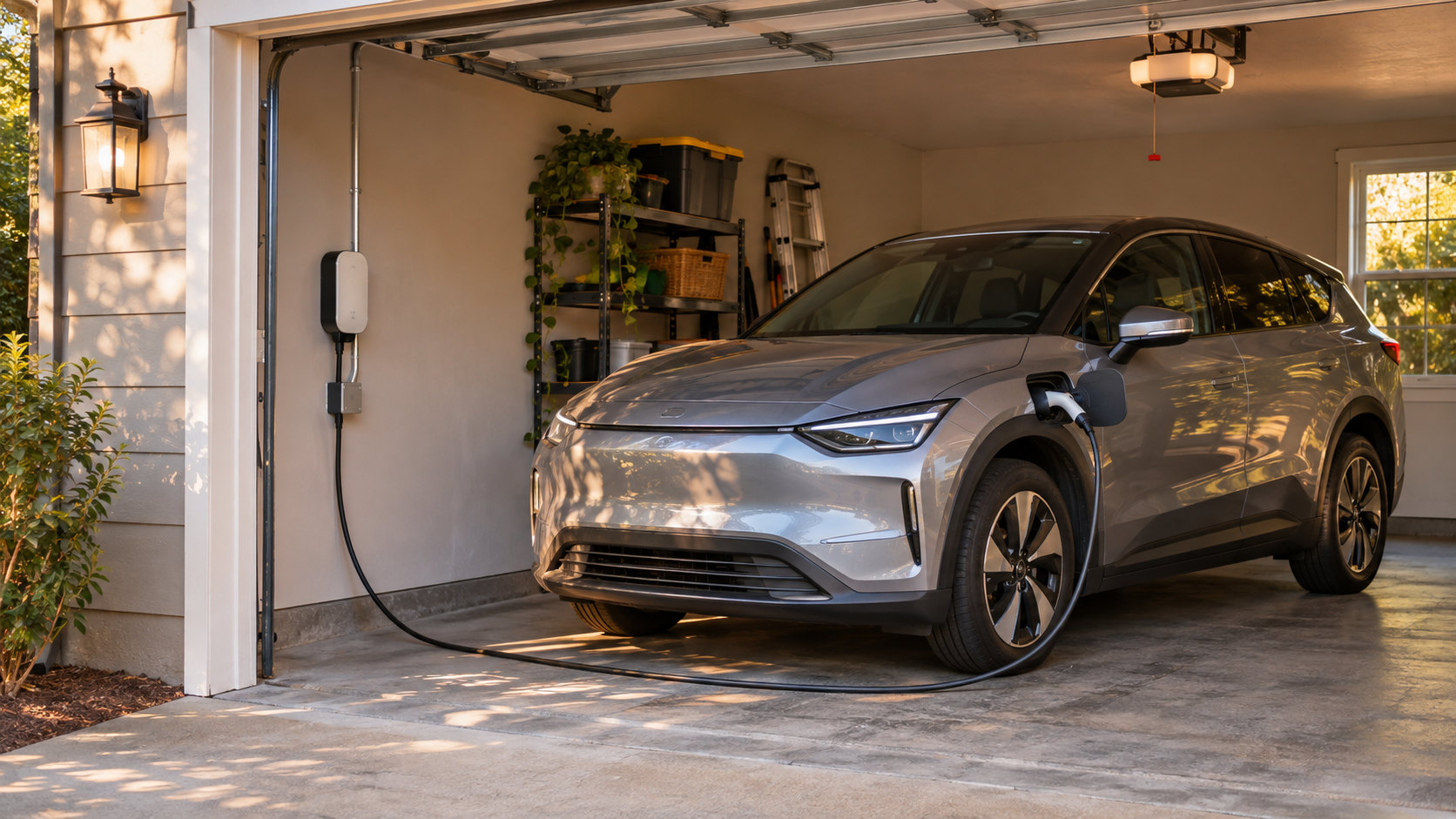
A garage outlet can make a Huntsville listing look “EV ready.” It cannot tell you whether the circuit is suitable, whether your car can gain enough charge during your usual parking window, or whether a wall charger was installed with the records you would want to see. Before you treat charging as a feature of a particular home, separate those three questions.
Start with the hours your car actually sits at home
The U.S. Department of Energy’s home-charging guide says many drivers can cover their daily driving with overnight Level 1 charging when a suitable outlet on a dedicated branch circuit is near the parking place. Level 2 uses 240-volt equipment and can be worth investigating for a longer commute, a less regular schedule, or a vehicle that needs more charging during its typical time at home. Those are reasons to investigate, not a promise that either option works at this address.
| What your routine looks like | Start the conversation here | Still verify at the property |
|---|---|---|
| Predictable driving and a long overnight parking window | Ask whether Level 1 meets your vehicle’s actual daily energy need. | Have a qualified electrician confirm a suitable dedicated circuit near your parking space. |
| Longer trips, irregular hours, or a shorter parking window | Ask an electrician to assess a Level 2 installation for the specific home. | Confirm available electrical capacity, equipment location, permit path, and a written scope. |
| An installed charger appears in the listing | Ask for its model and the installation record before counting it as a benefit. | Check compatibility with your vehicle and have the installation evaluated; the wall box alone proves neither. |
Make the calculation personal: record your vehicle model, usual miles between charging opportunities, and hours parked at home. Check the vehicle maker’s charging specifications, then ask a qualified electrician to assess the property. The DOE recommends that sequence before equipment or electrical work is purchased. A universal “miles per hour” claim would hide differences among vehicles, equipment and electrical systems.
For scale, the DOE’s charging-station guide gives an illustrative Level 1 case: eight hours at 120 volts can replenish about 40 miles of electric range for a midsize EV, assuming 1.9 kilowatts of charging power. That is not a rate promised by a house or every car. The vehicle, equipment, circuit and available power can change the result. If your usual driving uses roughly that much range and the car reliably sits overnight, Level 1 may merit a property-specific assessment; a shorter window or more driving makes the Level 2 question more urgent.
Walk the parking place, then ask about the circuit
On a tour, note where the vehicle would park, where its charge port would face, and whether charging would happen in a garage or outside. Photograph the existing receptacle or charging equipment only with the seller’s permission, and keep its model information for the professional who assesses it. The DOE says an outdoor setup needs outdoor-rated equipment. A convenient-looking outlet, a free panel position, or a listing description does not establish the circuit or whole-home capacity needed for your plan.
Ask a qualified electrician to identify the existing circuit, assess the home’s electrical capacity and the proposed equipment, and give you a written scope for any change. The DOE specifically cautions that some homes have insufficient capacity for Level 2 charging and that installations must comply with local and state requirements. Do not turn a home tour into a do-it-yourself electrical test.
For a city address, trace the permit and inspection evidence
If the exact property is inside Huntsville city limits, ask the electrician and the City of Huntsville Inspection Department which permit and inspection steps apply to the proposed work. The city’s license guidance says electrical contractors must be certified by the appropriate state board and purchase permits for their trade. The permit path depends on the actual work and jurisdiction; a Huntsville mailing address alone is not proof the city administers that property.
For an existing charger, request the installer’s information, equipment model, permit number if one was required, and completed inspection evidence from the seller or installer. Huntsville’s inspection page describes an online system that can show permit inspections, pass or fail status and inspector comments; access requires a taxpayer ID and passcode. It does not give a prospective buyer unrestricted access. If the seller cannot produce records, ask the city and your qualified electrician what can be verified rather than assuming the installation passed.
A general home inspection is still useful, but an EV charging question may need a specialist’s evaluation. My Huntsville inspection and appraisal guide explains why an inspection, a targeted follow-up and a lender’s appraisal answer different questions.
Try the question on two homes before you make an offer
Home A has a garage receptacle and an easy overnight parking routine, but nobody has documented a dedicated circuit. Level 1 is a reasonable question to take to an electrician, not a feature to count as verified. Home B has a wall-mounted charger beside an outdoor parking space, but no equipment or inspection paperwork. Its visible convenience does not resolve weather suitability, vehicle compatibility or the installation record.
For either home, make the offer-stage request specific: “Can we identify the equipment and records, get a qualified assessment of my charging plan, and learn the written scope and applicable city or county process before I commit to an assumption about charging?” Discuss timing and any contract contingency with your own real estate and legal advisers. The answer may be simple, may require work, or may change which home better fits your routine.
Featured image is an AI-generated generic garage scene, not a Huntsville property or an example of an assessed installation.
Final Thoughts
The useful comparison is your charging window plus a qualified assessment for each address. A photographed outlet and an unverified charger should remain open questions until the circuit, equipment, capacity and applicable permit record are understood.
Want Personalized Real Estate Help?
I can help you compare Huntsville-area homes with your parking and charging questions in mind, and coordinate the property information you need to discuss with a qualified electrician. Contact me to plan your search. You can also explore homes across the broader Huntsville area; listing photos and filters do not verify EV charging readiness or city jurisdiction.
Sharing is Caring:
Author

Sources and review notes
Context: Try the question on two homes before you make an offerSources: U.S. Department of Energy Alternative Fuels Data Center and City of Huntsville pages reviewed November 16, 2026.