Jessica Hassan
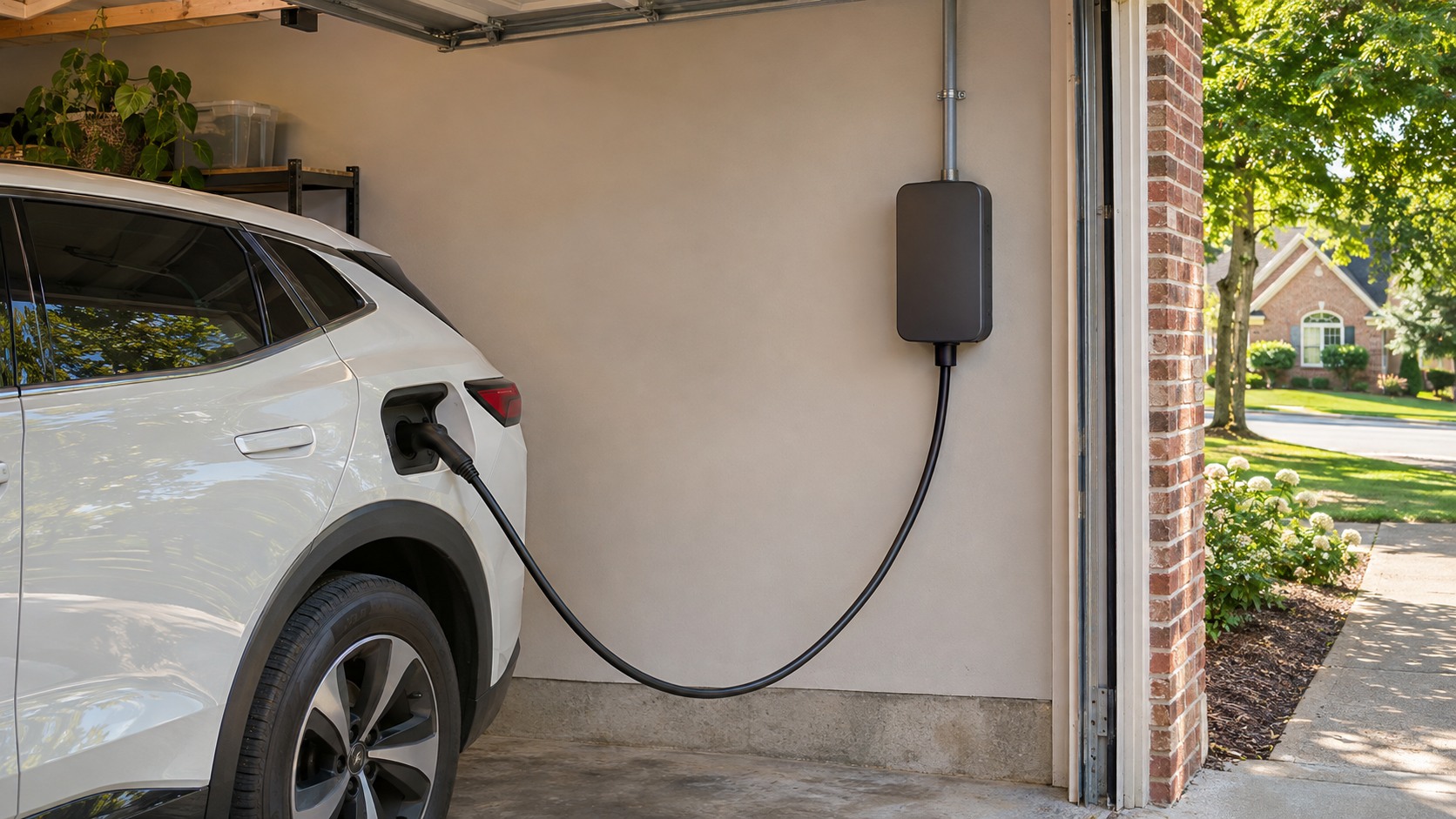
The useful question for home EV charging is how much driving you need to replace before you leave again. A car parked all night after a short day has a different charging job from the same car arriving late after a long trip. In Huntsville, that choice also meets two separate local systems: your electric provider supplies power, while the municipality or county handles the applicable permit and inspection process.
Level 1 or Level 2: match charging to the hours you have
Level 1 uses 120-volt power; residential Level 2 uses 240 volts. The Department of Energy’s home-charging guide explains that overnight Level 1 can meet many drivers’ daily needs when a suitable dedicated-circuit outlet is available near parking. Level 2 provides more flexibility for longer driving days and shorter stays at home. Outdoor charging requires outdoor-rated equipment.
Think about replacing the day’s driving rather than filling an empty battery every night. A full-battery charging time answers a different question from “Will I recover today’s miles by morning?” Huntsville Utilities’ EV guide gives broad estimates of 3–5 miles of range per charging hour for Level 1 and 20–30 for Level 2. Those are orientation ranges, not guarantees for a particular vehicle.
| Charging choice | Where it may fit | What it changes |
|---|---|---|
| Level 1 · 120 volts | Modest daily driving with a long, predictable overnight parking window. | Slower replenishment may fit the routine without a new Level 2 unit, if the existing outlet and circuit are suitable. |
| Level 2 · 240 volts | More daily driving, a short turnaround at home, or a need to recover from a longer trip sooner. | Faster replenishment, with an installation that needs an electrical-capacity assessment. |
An overnight example makes the tradeoff clearer
Hypothetical example: suppose a driver needs to replace 40 miles and has ten hours at home. Using HU’s broad estimates, Level 1 would add roughly 30–50 miles in that window. At the lower end, it would not replace the full day’s driving; at the upper end, it would. Level 2’s stated range would replace those 40 miles in roughly 1⅓–2 hours.
This arithmetic assumes the quoted rate continues through the charging period. It is not a vehicle test or a full-battery prediction. The lesson is the margin: a plan that only just meets a normal day leaves less room for an extra errand or a late arrival. Compare your vehicle’s charging information with your actual weekly routine, including the longest days you expect to handle at home.
Faster charging should not be confused with a special overnight electricity price. HU’s EV page says its regular electric rates apply and it does not have a peak-rate schedule. Do not import a time-of-use savings assumption from a previous utility when planning a move here.
Your utility account and your permit address answer different questions
Huntsville Utilities describes its electric territory as Madison County and a small portion of Marshall County. That service territory is not the City of Huntsville’s boundary. For a particular home, the provider on the electric account identifies the utility; the City of Huntsville limits map helps identify whether the parcel is inside the city. A Huntsville mailing address alone does not settle the permit jurisdiction.
For work inside Huntsville, the City’s Building License & Permits instructions say most electrical trade permits can be obtained online. There is a significant exception: projects in a FEMA Special Flood Hazard Area must be submitted in person. The City also says all building permits and most standalone trade permits need a Flood Development Permit first. These are process rules, not a blanket finding that every charging arrangement needs the same permit.
Give City Inspection at 256-427-5331 the actual scope: an existing outlet, a new circuit, a hardwired unit, or panel/service changes. Those are different projects. Outside Huntsville city limits, HU’s Inspection Agencies directory lists separate local offices, including Madison, New Hope, Owens Cross Roads and Madison County. Use the office responsible for the parcel rather than sending a city application simply because HU supplies the electricity.
Evaluate the installation, not just the wall unit
The charging equipment is only one part of the job. A qualified electrician assesses whether the home has the electrical capacity for the proposed equipment. DOE identifies EV charging as a continuous electrical load, so a photograph of the panel or a spare-looking breaker position is not an installation design.
A useful written estimate separates the charging unit, circuit and wiring, any panel or service changes, and permit and inspection costs. It should also identify who obtains the permit and arranges inspection. That makes two quotes comparable: a lower price for only the wall unit cannot be compared fairly with a price that includes wiring and service work. The Alabama Board of Electrical Contractors consumer page provides a license-search route.
Parking matters during a home search, too. Where will the car actually sit, and who controls the space and the equipment? In a rental or shared building, owner or association permission may be a separate part of the plan. For a house already showing a charger, put equipment inclusion and available installation records into the purchase discussion rather than assuming the photograph answers either question.
Final Thoughts
A workable home-charging plan gives you enough recovery time for your routine and a priced installation for the actual home. Level 1 may be sufficient; Level 2 may buy useful flexibility. The important comparison is the charging time you need, the electrical work the property needs, and the local approval path. Once charging becomes part of your household use, my Huntsville Utilities billing guide explains how billing-period length and payment plans affect what you see on the statement.
Want Personalized Real Estate Help?
If EV charging is part of your next move, I can help keep parking, included equipment and installation timing in the home-search conversation. Contact me to talk about what your daily routine needs from a home, or explore Huntsville-area homes for sale as a starting point. Individual listings still need their own utility and electrical assessment.
Sharing is Caring:
Author

Sources and review notes
Official charging and City permit sources reviewed November 6, 2026. Charging examples are illustrative; no individual property or installation was evaluated.